|
Published by Contemporary Research Center CRC Publications |
 |
|
|
|
Challenges Facing Implementation of Competency-Based Assessment in Kenyan Primary Schools, Case of Kajiado CountyROBERT O. OPONDO
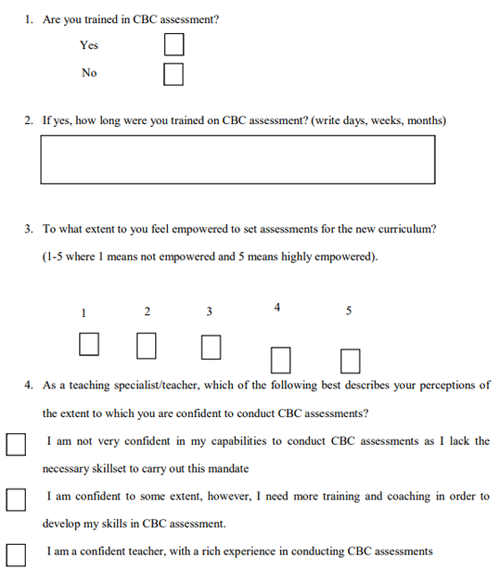
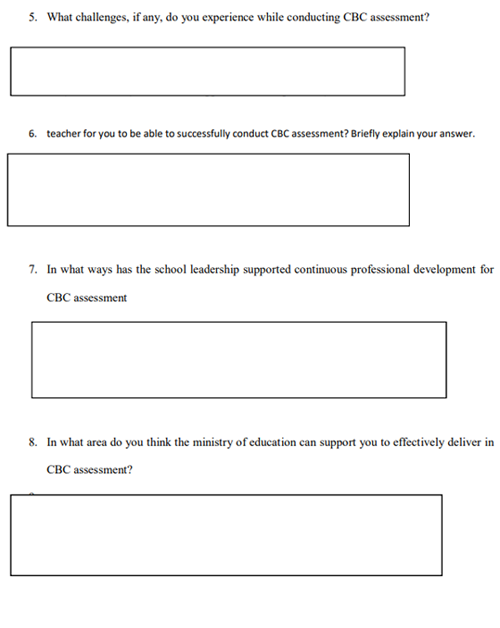
Abstract The study sought to investigate challenges encountered by Kenyan teachers in implementing a Competency-Based Curriculum (CBC). The research focused on the assessment component. Data was collected in Kajiado county (Kajiado North & central sub-counties). 10 schools were randomly selected and 3 teachers per school were engaged in interviews and classroom observations. The study findings show that teachers were inadequately trained to deliver and assess CBC which affected their teaching and assessment of CBC. Other factors affecting the delivery of CBC include inadequate staffing, class size, resources needed for CBC assessment, and lack of support from parents. Extensive teacher training both at the college level and inform with Continuous Professional Development (CPD) in CBC is recommended. Careful consideration by the ministry of education while allocating resources including teaching staff should be adopted. Finally, sensitization to parents and other stakeholders will help positively change their perception of CBC. Keywords: Competency- Based Curriculum (CBC), Competency-Based Education (CBE), Pedagogy. 1. Introduction 1.1 Background of the study Education by far and wide is one of the pillars of national development (Elizabeth, 2011). The need to solve unemployment among youth led the Government of Kenya through the ministry of education to seek a major solution. It was suggested that the best way was to equip learners with vast skills and knowledge in areas of their competencies (Kim, Raza, & Seidman, 2019). To attain that, the previous curriculum of 8-4-4 could not help us to attain that, therefore the shift to a Competency-Based Curriculum (CBC). The competency-based curriculum under the 2-6-3-3 system of education in Kenya was unveiled in 2017 to replace the 8-4-4 system of education which has served Kenya for the last 32 years. According to (KICD, 2021), the core competencies of CBC are communication and collaboration, critical thinking and problem-solving, imagination and creativity, citizenship, learning to learn, self-efficacy, and digital literacy. The core pillars of CBC content are audience and business. CBC requires learners to construct their knowledge, moving at their own pace, graduating based on demonstration of competencies. Yet with a large number of learners in Classrooms in Kenyan schools, teachers are likely to be faced with many challenges. CBC curriculum hopes to impact eight core values: love, responsibility, respect, unity, peace, patriotism, social justice, and integrity (Warrior,2019; KICD,2017), A competency-based curriculum is an approach to learning where students work at their own pace to demonstrate mastery in the competency recessing their chosen field of study (Grube,2018). CBC promotes individualized learning and accommodates a variety of learning styles, making it a personalized experience. 1.2 Significance of the study From various observations conducted in public primary schools in Kenya, the researcher noticed that teachers find it challenging to assess students who are learning through a competency-based curriculum. This study aims to find viable solutions to challenges facing primary school teachers while conducting competency-based assessments. The suggested solutions and recommendations of this study will be helpful to education stakeholders, teacher training institutions, and teachers. The study was guided by the following objectives; challenges encountered by teachers while using competency-based assessment in learning, and solutions to challenges faced by teachers while assessing students in a competency-based curriculum. The following are the research questions that guided the study; what are the Challenges encountered by teachers while using competency-based assessment in learning, and what are solutions to challenges faced by teachers while assessing students in a competency-based curriculum? Literature Review The literature review chapter includes; Competency-based education, competency-based assessment, competency-based assessment education, and solutions to challenges facing competency-based assessment in Kenya. 2.1 Competency-Based Education Education is a tool to increase the totality of possibilities for national development. Moon (1994) introduces the two facets of education; first education is responsible for identifying and nurturing the potential ability of a learner (self-actualization) and second as responsible for ensuring societal progress and development through the supply of manpower. At the onset, the two functions were intertwined, hence the sole objective of education was to optimize individual abilities as well as secure the needed human capital. Over time the push by political leaders to have a competitive society lead to the divergence of the two otherwise inseparable functions. This was due to the emphasis by the leaders on manpower production at the expense of the self-actualization function. Educational relevance is measured in terms of the degree of balance between the two functions. The best case scenario is characterized by encouraging the students to work towards actualizing their optimal potentials and “utilize the abilities in accordance to their talents” (Moon, 2007, P.338). The competency-Based Education model promotes the identification and molding of the different abilities (intellectual, emotional, and physical) in the learner. Rahman (2014) defines competence as the consistent application of knowledge and skills concerning a performance standard. The CBE model is distinguished from the traditional model by the following characteristics: A view of education as a collection of activities designed to optimally stretch individual student’s abilities, Availability of a myriad of alternatives for the students to acquire a diverse range of experiences. This is achieved through a twofold learning where subject-based study inculcates the foundational knowledge alongside potential-development activities, distribution of learning hours to cater for experience, presentation, and subject-specific activities in a balanced manner with emphasis on activities that cultivate an experience, and application of diverse criteria such as talent, amplitude, and ability in evaluating students. The second facet seems to be the major driver of CBC adoption in several countries. An example case is the UK which implemented CBC to address the bloating unemployment rates (Rahman,2014). Young people graduating from the different training institutions did not have the relevant skills demanded by their profession. The US similarly favored CBC as a curriculum capable of addressing the educational challenge of teacher training. The view of Competency-Based Education (CBE) is to ensure that education plays the role of identifying and nurturing the potential of a country’s citizens (Moon,2007). Long term viability of CBE programs is pegged on the credibility of credentials obtained upon completion in the eyes of the employer. Credibility on the other hand is directly proportional to the quality of the assessment. 2.2. What is competency-based assessment? Competency-based education is an organizational or system approach to schooling and learning where students move ahead primarily based on the demonstration of what they know and do rather than the time spent in class according to KICD (Jackeline Onyango –ECD conference July 2018). Contrary to traditional assessment which assesses students’ achievement levels of the predefined objectives, CBC is rooted in authentic assessment with emphasis on the application of knowledge and skills in a real-world context (Rahman, 2014). CBC should strive to provide authentic, alternative, and performance assessments. 2.3 Competency-based assessment is a measurement. It is the type of assessment that provides insight into what the student knows, needs to learn, and has learned and where the institution can improve. It involves peer learning assessment, formative assessment, and summative assessment. Kenya CBC emphasizes continuous assessment to ensure that special needs academic progress is monitored and where help is needed. This type of assessment is done by teachers. While discussing best practices for CBE assessment, McClarty et. al identified assessment instrument validation and setting sensible competency yardstick pegged on a myriad of sources of evidence as the two areas of assessment design and implementation that calls for significant and sustained attention (McClarty,2015). The type of assessment used in competency-based education is Formative and summative assessment. Formative assessment involves gathering information on learners’ progress during the learning process by use of assessment tools. It is aimed at providing immediate feedback to learners to improve the attainment of learning outcomes. There are two types of formative competencybased assessment; Assessment for learning and assessment as learning. Assessment for learning (AFL) is an approach that helps the teacher to gather information on learners’ performance and provide feedback that is used to improve instructional strategies. Also, to use the results to modify and improve teaching techniques during the instructional process. The learner becomes more involved in the learning process and gains confidence in what they are expected to learn and what is standard. The teacher uses a variety of assessment tools such as individualized observation oral/nonverbal questioning, assessment portfolio, checklist, and rating scale to find out the current level of performance or entry behavior and determine the kind of support to provide. Assessment as learning occurs when the teacher helps a learner to set individualized goals, monitor their progress, self-assessment, and reflect on one’s learning. This helps the learner develop a capacity to be independent, and autonomous and acquire lifelong learning skills (learning to learn). Teachers encourage the learner to reflect on peer feedback, accommodate peer coaching as well as monitor the attainment of the set goals. 2.4 What are the challenges faced by the teacher while using competency-based assessment in teaching and learning? The implementation happens with little regard for available capacities and resources. For example, teachers' values, practices, and beliefs majorly shape the outcome application. Factors affecting CBC are time issues, parental expectations, public review, unavailable Research Methodology The study used a qualitative research methodology. The research method was used due to its ability to use interviews and classroom observations Data collection was done using structured interviews and classroom observation. Data was collected in Kajiado county (Kajiado central and kajiado North sub-counties). The county was selected due to its nature of lagging academically in the national examinations. The two sub-counties were selected due to their proximity to the researchers making it easy to collect data through lesson observations and interviews. Purpose random selection was used to obtain sample schools for the study. 10 schools were randomly selected and 3 teachers per school were engaged in interviews and classroom observations. The research findings are to enable the teachers to use the study recommendations to improve student’s performance in the newly introduced CBC curriculum. 4.0 Results and findings Analysis of the findings is categorized by the study research questions. 4.1 Challenges encountered by teachers while using competency-based assessment in learning. Inadequate teachers training The study findings show that teachers were trained in CBC assessment, but only for less than a week. This indicates that they have an idea of CBC training but lack sufficient knowledge of CBC pedagogy. Few teachers understood CBC pedagogy. Most of them were struggling with the concept and lacked the capacity demanded by the curriculum. It was reported that the poor training plan in terms of content and delivery methods incapacitates CBC implementers from efficiently conducting learner assessments. It was reported that teachers training in CBC assessment was minimal. The training was conducted for one to two days duration. Most of the training done was through peer training, whereby a few teachers were selected trained, and then deployed to teach others in their schools. Teachers mentioned that peer teachers may go off tasks as they are working with their friends, they also suggested that it was difficult to learn much because peer teachers are not as experienced as the CBC trainers, therefore leading to poor content delivery. In a study made by Harris and Brown (2013) on the usage and implementation of peer response in their classroom, research findings show that students tended to value teacher’s responses higher than peer responses. In addition, it was raised that peer training was downplayed because peers are not qualified to give training because they lack sufficient training (Hu &Lam, 2009). In the study, 65% of participants showed that the training was done in less than a week. This shows that the CBC training was insufficient in that within those few days they had to learn how to conduct CBC learning and assessment. These usually lead to incompetent implementers who lack mastery of curriculum and assessment in learning. Lack of teachers’ empowerment It was reported that teachers' empowerment in setting assessments in the CBC curriculum is minimal. This is because 77% mentioned that they are somehow empowered, and 23% felt empowered. For a teacher to be empowered there is a need for sufficient training and continuous professional development. It was learned that the government through the ministry of education did not have proper strategies for empowering CBC-implementing teachers, though they trained teachers, the training was efficient. Lack of confidence to use CBC assessment Over 80% of the respondent felt they are confident to conduct CBC assessments to some extent; however, there is a need for more training and coaching to develop skills in CBC assessment. 80% of the respondents reported being somehow confident to conduct CBC assessments, and their major concern was the need for more training and coaching to develop CBC assessment skills. Teachers lack confidence in conducting CBC due to inadequate knowledge and skills in CBC assessment. Most teachers lack sound knowledge on how to implement certain aspects especially to conduct an assessment of CBC. Teachers mentioned a lack of correct guidance on how to conduct learning and assessment. It was raised that there wasn’t training on how to carry out classroom activities and on what is expected of one to do. The study findings show that CBC curriculum structure is one of the challenges hindering effective CBC assessment. Teachers reported that the CBC assessment process is complicated. The curriculum is designed in such a way that most of the activities take place at the same time, so in case of student or teacher absenteeism it becomes difficult for teachers to effectively carry out an assessment, (Amunga et al,2020). Concerning the challenges experienced, most of the teachers cited a lack of resources (textbooks), funds, learning materials, internet connection, or ICT tools, and a lack of knowledge and skills (inadequate training) as the main challenges. Resources contributed largely to how CBC assessment was being conducted, it was reported that teachers hardly had resources such as textbooks, learning material, internet connections, and ICT tools. The inability to access resources used in learning CBC, hugely affected the assessment process. Teachers mentioned the poor assessment strategies were due to a lack of properly written guidelines to enable them in assessing learners. A study conducted by Okongo et al (2015), on the effect of the availability of teaching and learning resources on the implementation of inclusive education in preschool centers. The study findings revealed that there were inadequate teaching and learning resources affected the implementation of inclusive education. Adeogun (2001) discovered a strong positive significant relationship between instructional resources and academic performance. The large class size which derails CBC pedagogy and assessment is also featured. Most Kenyan public primary schools have a large number of students per classroom. Most teachers reported having 60 to 80 learners in their classrooms. Since CBC assessment is a continuous process, teachers find it challenging when it comes to assessing the individual learner. Large class sizes make it impossible to conduct frequent assessments and provide timely feedback to students which is crucial in improving students’ performance. A study was conducted Cuseo, Joe. (2007), show that large class sizes determine a significant and sizeable negative effect on students’ performance. Also, the gross understaffing of teachers in public schools makes it difficult for teachers to attend to learners in case of emergency issues that call for teacher absenteeism. Also, one teacher has to cover many overwhelming lessons. Lack of parental support was another challenge that was mentioned. Most of the parents whose children are currently studying the CBC curriculum are products of the 8-4-4 system, while others are illiterate. They have little knowledge of the new curriculum. This makes it difficult for them to understand what is going on in the curriculum and not able to assist their children with homework and other required home supervision. This makes the implementers of CBC difficult because of the lack of parental support and involvement yet teachers and parents are supposed to work hand in hand as collaborators and co-educators for the implementation of the new curriculum to be successful,(Amunga et al,2020). 4.2 Solutions to challenges faced by teachers while assessing students in a competency-based curriculum Level of teacher support in conducting CBC assessment CBC assessment requires support from peer teachers, school administration, and the ministry of education. The study findings show that 80% of teachers lack support while conducting CBC assessments. The respondents argued that they lack government support, parental support, and school support. The major ideas that were mentioned were insufficient training, minimum support from parents yet CBC requires parental engagement, and lack of resources to conduct CBC asssement.60% of the respondents mentioned that they had little understanding of the CBC curriculum and CBC assessment. They mentioned that there was confusion about the whole CBC implementation. Most teachers feel that there exists confusion in the overall implementation of CBC leaving some of them to guess their way about most of the aspects. Continuous Professional Development support by schools The continuous professional development rate in schools is low, as most teachers stated that they receive little or no support from the administration. The study findings show that teachers received training from their peers who had been trained during the rolling out of the CBC curriculum. School administrations hardly participate in CBC assessments due to a lack of CBC curriculum knowledge and expertise. (Nsibande,2002), study shows that principals in schools who lack knowledge of the curriculum are not in a position to help the teachers, lack of curriculum knowledge and inability to understand the curriculum lead to poor planning and lack of confidence when teaching. It was learned that head teachers need to be trained so that they support CBC implementing teachers. Conclusion and Recommendations For successful CBC assessment results, the government through the ministry of Education needs to provide resources such as learning resources, offering regular and comprehensive CBC training, sensitize teachers and the public on the importance of the CBC curriculum, offer adequate and more training on CBC assessment, provision of all required learning material (shows the material are inadequate), Internet installation The government through the ministry of education to empower teachers by training them in ICT knowledge, skills, and CBC pedagogy skills. Teachers should incorporate the use of technology in the assessment. This will help to explore and access new ideas and tasks as well as assist in finding new ways of handling tasks. The government through the ministry of education and education stakeholders to sensitize the public on CBC, also sensitize parents on the importance of parental involvement in CBC education, and fund continuous professional development training in schools, to equip teachers with knowledge on various aspects of CBC School leaders organize local school-based continuous professional development sessions in their schools so that all teachers in the school are informed and skilled in various areas of the CBC curriculum, and school leaders actively participate in CBC implementation by constantly supporting implementing teachers. CBC assessment has majorly been reported to be formative, hence teachers should consider including the summative assessment. Need for implementing teachers to liaise with their colleagues who have a vast knowledge of CBC assessment, to gain knowledge on how to conduct it. The government through the ministry of education provides resources such as learning resources, offering regular and comprehensive CBC training, also sensitizing parents and the public on the importance of the CBC curriculum, Offer adequate and more training on CBC training. There is a need to sensitize teachers and the public on the importance of the CBC curriculum, Offer adequate and more training on CBC assessment. Also, Provision of all required learning material and Internet installation. Interview Interview Questions to assess the level of CBC assessment preparedness among Kenyan teachers. 1. Are you trained in CBC assessment?
References Amunga, J., Were, D., & Ashioya, I. (2020).The Teacher-Parent Nexus in the CompetencyBased Curriculum Success Equation in Kenya. International Journal of Educational Administration and Policy Studies, 12(1), 60–76 Cuseo, Joe. (2007). The empirical case against large class size: Adverse effects on the teaching, learning, and retention of first-year students. J Faculty Dev. 21. Goos, M. (2010). Using Technology to support effective mathematics teaching and learning:What counts? 67–70 McClarty, K.L. and Gaertner, M.N. (2015). Measuring mastery: Best practices for assessment in competency-based education. American Enterprise Institute for Public Policy Research. https://bit. ly/2MN1m04. Moon, Y. (2007) ‘Education reform and competency-based education’, Asia Pacific education review, 8(2), pp. 337–341. doi: 10.1007/BF03029267. Moon, Y. L. (1994). The direction and strategies of education reform in Korea, Criticism Quarterly, 36(1), 119-126 Mulenga, I. M., & Kabombwe, Y. M. (2019). Understanding a competency-based curriculum and education: The Zambian perspective. Ondimu, S. M. (2018).Teachers’ Preparedness for Implementation of the Competency BasedCurriculum in Private Pre-schools in Dagoretti North Sub-county, Nairobi CityCounty. University of Nairobi Rahman, A. bt A. et al. (2014) ‘Assessment Practices for Competency based Education and Training in Vocational College, Malaysia’, Procedia, social and behavioral sciences, 112, pp. 1070–1076. doi: 10.1016/j.sbspro.2014.01.1271. Schuwirth, L. and Ash, J. (2013) ‘Assessing tomorrow's learners: In competency-based education only a radically different holistic method of assessment will work. Six things we could forget’, Medical teacher, 35(7), pp. 555–559. doi: 10.3109/0142159X.2013.787140. Soare, E. (2015) ‘Perspectives on Designing the Competence Based Curriculum’, Procedia, social and behavioral sciences, 180, pp. 972–977. doi: 10.1016/j.sbspro.2015.02.259.
|
ISSN: 2411-5681 Online & Print Journal Information
Frequency: Monthly
News Attention to Authors The latest issue |
|
Copyright © 2013-2026 IJER - International Journal of Education and Research. All Rights Reserved • Privacy Policy |