|
Published by Contemporary Research Center CRC Publications |
 |
|
|
|
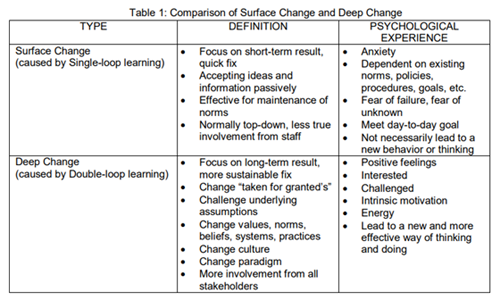
Single-Loop vs. Double-Loop Learning : An Obstacle or A Success Factor For Organizational LearningPornkasem Kantamara &Vichita Vathanophas Ractham College of Management, Mahidol University (THAILAND)vichita.rac@mahidol.ac.th, pornkasem.kan@mahidol.ac.th Abstract The economic downturn currently spreading around the world comes with chaos and high uncertainty and has caused organizations, public and private alike, to reconsider their overall strategies in order to survive and stimulate recovery. This paper explores the concept of single-loop and double-loop learning processes, as innovation, and its relationship and influence on change management and organizational learning. In an organization, when an error is detected or a problem is identified, managers often make a business decision based on set rules, norms, procedures, processes, and assumptions without questioning them. This kind of single-loop learning has worked before. So, why should it not work now? The problem is it may not, because the rules and assumptions have changed. There are many factors that drive change: globalization, information age, advance technology, global economy, environmental concerns, etc. Change is a constant state today and is happening at an alarming rate. Thus, norms, old rules, procedures, processes, and assumptions may not work any longer. An organization and its people need to change the way they think, solve a problem, and implement change in order to keep up with the external environment. Learning and problem solving in the external environment or outside-in alone is not sufficient and does not lead to persistent learning or sustainable change. Managers and employees must also look inward and need to reflect critically on their own behavior, identify the ways they often inadvertently contribute to the organization’s problems, and then change how they act. In particular, they must learn how the very way they go about defining and solving problems can be a source of problems in its own right. Thus, in double-loop learning, problems are tackled from inside-out. Their root causes are identified and handled or overcome, not simply remove the visible external symptoms which do not lead to a true cure. In this paper, the authors describe the study conducted to investigate how single-loop and double-loop learning processes influence learning in an organization through change management process. From this study, organizational leaders will be able to develop more effective strategies to implement a systemic and sustainable change in their organization which is more complex and requires a higher level of learning. The study is an on-going processwhichwill propose the strategies in which an organization handles the change circumstance and enhances a sustainable organizational learning in the future. Keywords: Single-loop learning, double-loop learning, organizational learning, change management 1. INTRODUCTION The economic downturn currently spreading around the world comes with chaos and high uncertainty and has caused organizations, public and private alike, to reconsider their overall strategies in order to survive and stimulate recovery. This paper explores the concept of single-loop and double-loop learning processes, as innovation, and its relationship and influence on change management and learning in an organization. Human beings have a tendency to follow the same pattern when it comes to the way they lead their life or when they need to solve a problem. This same pattern with the same set of rules, values, norms, goals, procedures, processes, and assumptions provides them with psychological safety – or, peace of mind. This is single-loop learning which occurs when errors or problems are detected and corrected and organizations carry on with their policies and goals. The activities to correct errors and solve the problems add to the knowledge-base or firm-specific competences or routines without altering the fundamental nature of the organization’s activities. On the other hand, double-loop learning occurs when, in addition to detection and correction of errors, the organization is involved in questioning and modification of an organization’s underlying norms, procedures, policies, and objectives. The process involves changing the knowledge-base or firm-specific competences or routines. The next sections will introduce the concepts of organizational learning in the aspect of single-loop and double-loop learning, change management process, followed by the research framework for this study. 2. SINGLE-LOOP VS. DOUBLE-LOOP LEARNING Learning can be defined in many aspects. Some consider that behavior change is required for learning (Argyris &Schön, 1996; Garvin,1993). Some required new knowledge as an output from knowledge as an input (Levitt & March, 1998). Piaget (1972) defined mutual interaction of accommodation as the critical success factor to learning while Kolb (1984) describes experience transformation to lead to learning process. Moreover, learning is defined as rising individual capability to take effective action. (Kim, 1993). A clear definition has shown to be indescribable over the years. However, most are of the same opinion that organizational learning is an important process of sustainable competitive advantage (Easterby-Smith, 1995). There are two main organizational learning levels in established literatures; single-loop learning and doubleloop learning. Single-loop learning is one of the problem-solving processes. Individuals usually examine the environment, compare data with the norm, and then initiate an appropriate action. Individuals look at what options they have and fix the problem.They respond to changes internally or externally by discovering and amending mistakes to maintain the features of the organizational norm. This is single-loop learning which occurs when errors or problems are detected and corrected; and organizations carry on with their policies and goals. The activities to correct errors and solve the problems add to the knowledge-base or firm-specific competences or routines without altering the fundamental nature of the organization’s activities(Argyris, 1977;1991). On the other hand, double-loop learning is the process of comparing the situation with the norm, questioning whether the norm is appropriate and justifying whether this is the best means of doing things. The current organizational norms will be questioned to, may be, establish a new set of norms. The organization is involved in questioning and modification of an organization’s underlying norms, procedures, policies, and objectives. The process involves changing the knowledge-base or firm-specific competences or routines (Argyris, 1977;1991). Double loop learning is shown to be more suitable for undertaking the existing turbulence and invariable change in the environment. (Senge, 1994; Slater & Narver, 1995; Garcia-Morales, et al., 2009). There are links for organizational learning to the organizational ability to change or adapt to chaotic environment. Organizational learning purpose is to produce new knowledge and innovation related to continuous improvement. Moreover, double-loop learning has shown to be able to develop new organizational knowledge which is consequently integrated into learning organization model. Therefore, there is a possibly positive relationship between organizational learning and performance (Mabey & Salaman, 1995; Goh, 1998; Inkpen & Crossan, 1995; Senge, 1994). Organization learning is a process of detecting and correcting errors. However, top management is usually given fragmented information minimizing the amount of the problem and overemphasizing the issues which middle management is able to control (Argyris, 1977). When this situation takes place, it leads top management to lessen their concern and the problem is drawn out. Sooner or later, any errors in the organization will be hidden and fade away. Therefore, single-loop learning can possibly be described as obstacles of organizational learning; while double-loop learning can enhance the organizational learning. 3. CHANGE MANAGEMENT PROCESSES Change is a constant state today. With the current change drivers, such as, globalization, advance technology, information age, global economy, market maturation, etc., change is happening at an alarming rate. If an organization wants to maintain her competitive advantage, she has to change the way she thinks and the way she operates to be responsive to these change drivers. So do her people. Despite this fact, resistance to change is human beings’ natural state. Many scholars have studied about change in organizations (Schein, 1996,1999; Kotter& Cohen, 2002; Cummings & Worley, 2004; Hiatt, 2006) and developed different change theories to assist organizational leaders to lead change effectively and to help employees survive change and become more willing to embrace change.Peter Senge (1994) discusses the idea of “learning organization” in this book The Fifth Discipline. His main thesis is that if we are not learning, we are on the fast track to extinction. Change involves moving from the known to the unknown (Cummings & Worley, 2004). Single-loop learning, with its emphasis on the detection and correction of errors within a given set of governing variables, is linked to incremental change in organizations. This incremental change is sometimes not noticeable and only leads to what the authors call“surface change”. On the other hand, double-loop learning which involves interrogating the governing variables themselves often involves radical change and can lead to what the authors call“deep change”, such as the total revision of work process, reengineering, restructuring, alterations in strategy and so on. Taking into consideration the two levels of learning: Single-loop and Double-loop Learning, the authors propose there are two levels of change: Surface change and Deep Change, based on the two levels of learning process occurring within the change process. Table 1 below provides the comparison of Surface Change and Deep Change.
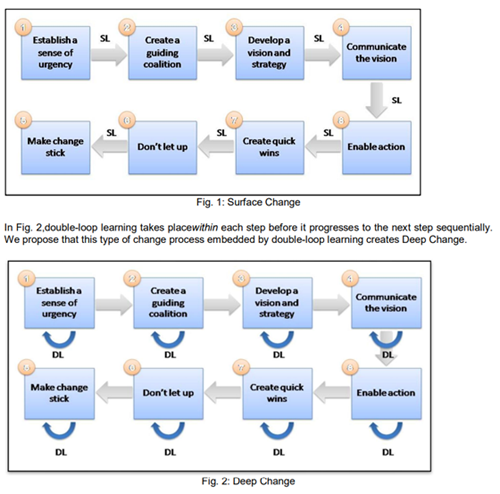
Change can only happen when an organization learns to adapt to the new world, to the new context she is performing in, and to the challenging and rapidly changing environment. She either changes deeply or at the surface depending on what kind of organizational learning she applies. In this paper the authors will explore how Kotter’s Eight Steps of Change Process (2002) and single- and double-loop learning interplay in organizational change implementation. The eight steps in this process are: 1. Increase urgency - The purpose of this step is to explain the cause(s) of change to all the stakeholders, especially the employees who will be affected by change directly. Normally, the level of complacency is high in an organization, particularly a successful one. Thus, this first step works as a wake-up call to reduce organizational complacency and to help employees to be aware of the need for change. 2. Build a guiding coalition–This step entails forming a group of staff members with the right characteristics or qualifications, such as, power, expertise, credibility, influence, and enthusiasm to lead change, and getting the group to work as a team. This guiding team has to build trust among them and develop their own understanding of the change vision in order to lead the others through the change effort effectively. 3. Get the vision right –To develop the future picture of the organization. This picture provides the direction of change to people and coordinate activities in the organization during the change implementation period. The right and compelling vision will inspire and motivate people to move beyond their traditional thinking, out of their comfort zone, and reduce organizational complacency. Moreover, the guiding team needs to develop bold strategies for making change vision a reality. 4. Communicate for buy-in – Sending clear, credible, and heartfelt messages about the direction of change is crucial. More often than not, communication is limited within a small group of top management who develops the vision; and thus, creates suspicion among lower level employees. In order for change to happen, organizational leaders and/or change agents need “gut-level commitment, and liberate more energy from a critical mass of people” (Kotter& Cohen, 2002). The key for this step is to use multi-channels and communicate repetitively. 5. Empower action – Rather than actually giving power, this step focuses on removing change obstacles that block people from acting on the vision, for instance, problematic supervisors, selfconfidence barriers, inadequate information, or malfunctioning systems. 6. Create quick wins – People tend to be impatient to wait and see the end result of change effort. As a result, quick wins need to be created as soon as they happen. These quick wins have various roles. They make progress visible, reward change agents, fine-tune vision and strategy, reduce resistance, keep managerial support, and build momentum. 7. Don’t let up – In this step, change agents or organizational leaders consolidate early changes and look for the next change to tackle in order to create wave after wave of change until the vision is fulfilled. 8. Make change stick– This means to institutionalize change in order to nurture a new culture, a new set of behaviors, new ways of thinking and doing things, or a new paradigm. Failing to make change stick leads to unsustainable change which wastes all the invested effort, time, and money. While there have been many studies conducted on change and change management, noresearch has been conducted to investigate the relationship between change and single-loop and double-loop learning and how these concepts influence organizational learning. 4. RESEARCH FRAMEWORK The authors propose that there are two levels of change. Surface change is a result of single-loop learning, while deep change is a result of double-loop learning. Fig. 1 shows how single-loop learning process manifests itself with the eight steps of the change process. The relationship between the single-loop learning appears only between each step of the process. This is a Surface change.
5. CONCLUSIONS While Single-loop learning is not necessarily an obstacle to organizational learning or change, it is not exactly a success factor for it only leads to a Surface Change. On the other hand, Double-loop learning is one of the success factors that lead to a Deep Change or a more real change, i.e. new behaviors and new thinking based on new underlying assumptions, values, beliefs, and goals. More importantly, if we could identify which steps in the change process require single-loop learning or double-loop learning, we will be able to implement change more effectively. And, obstacles can turn into success factors for organizational learning. REFERENCES [1] Argyris, C. (1977) Double Loop Learning in Organizations. Harvard Business Review, SeptemberOctober 1977, pp. 115-124. [2] Argyris, C. (1991) Teaching Smart People How to Learn. Harvard Business Review, May-June 1991, pp. 2-12. [3] Argyris, C., & Schön, D. A. (1996). Organizational Learning II: Theory, Method and Practice, Reading,Mass: Addison-Wesley [4] Cummings, T. & Worley, C. (2004). Organization development and change. Ohio: South-Western College Publishers [5] Easterby-Smith, M. (1995). Management learning in organizations. International Journal of Manpower, 16(1), pp. 66-68. [6] Garcia-Morales, V. J., Verdu-Jover, A. J., & Llorens, F. J. (2009). The Influence of CEO perceptions on the level of organizational learning. International Journal of Manpower, 30(6), pp. 567-590. [7] Garvin, D. A. (1993). Building a Learning Organization. Harvard Business Review. July-August 1993, pp.78-91 [8] Goh, S.C. (1998). Towards a learning organization: the strategic building blocks, SAM Advanced Management Journal, 63(2), pp. 15-20. [9] Hiatt, J.M. (2006). ADKAR: A model for change in business, government and our community.Colorado: Prosci Research. [10] Inkpen, A.C., & Crossan, M.M. (1995). Believing is seeing joint ventures and organization learning. Journal of Management Studies, 32, pp. 595-618. [11] Kim, D.H. (1993). The Link between Individual and Organizational Learning. Sloan Management Review, Jan 1993, 35(1), pp. 37-50. [12] Kolb, D. A. (1984) Experiential Learning, Englewood Cliffs, NJ.: Prentice Hall. [13] Kotter, J.& Cohen, D.S. (2002). The heart of change: Real-life stories of how people change their organizations. Boston: Harvard Business School Press. [14] Levitt, B., & March, J. G. (1998). Organizational learning. Annual review of Sociology, 14, pp. 319- 340 [15] Mabey, C., & Salaman, G. (1995). Strategic Human Resource Management, Blackwell Business, London. [16] Piaget, J. (1972). To Understand Is To Invent. New York: The Viking Press, Inc. [17] Schein, E.H. (1996). Kurt Lewin’s change theory in the field and in the classroom: Notes toward a model managed. Systems Practice, 9(1), pp. 27-47 [18] Schein, E.H. (1999). The corporate culture survival guide: Sense and nonsense about cultural change. San Francisco: Jossey-Bass Publishers. [19] Senge, P. (1994). The Fifth Discipline. New York: Doubleday. [20] Slater, S.F., & Narver, J. C. (1995). Market Orientation and the learning organization, Journal of Marketing, 59(3), pp 63-74.
|
ISSN: 2411-5681 Online & Print Journal Information
Frequency: Monthly
News Attention to Authors The latest issue |
|
Copyright © 2013-2026 IJER - International Journal of Education and Research. All Rights Reserved • Privacy Policy |