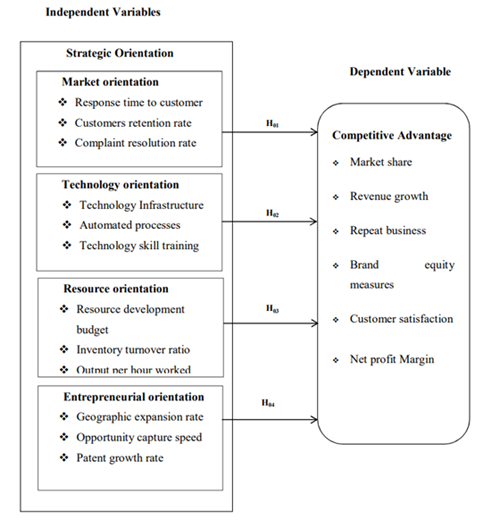
|
Published by Contemporary Research Center CRC Publications |
 |
|
|
|
Strategic Orientation as an Antecedent of Competitive Advantage : Evidence from Review of LiteratureNancy Wambui Njoroge Godfrey Mungai Kinyua ABSTRACT Strategic orientation is crucial in the growing global business environment as it provides a foundation for creating new organizational superiority. Companies with better strategic orientation stand 15% higher chances to have better growth and profitability compared to companies with weak strategic plans. This study aims to review the conceptual, theoretical, and empirical literature on the relationship between strategic orientation and competitive advantage with a view to highlight the knowledge gaps to inform the direction of future research. This review shows that market, entrepreneurial, resource, and technological orientations drive competitive advantage. However, gaps remain since most research focuses primarily on particular sectors while conducting studies within specific geographical areas using mostly quantitative methods and exploring only sectorspecific topics across different cultures. Insufficient research exists regarding the combination of market orientations with entrepreneurial orientations, resource and technology orientations. The majority of research centers on senior official opinions while omitting insights from staff members and market investors together with customers. Extensive thorough review of literature has aided in adoption of market share, profitability metrics, repeat business, and brand equity as suitable measures of competitive advantage. Further, strategic orientation has been deconstructed into market orientation, technology orientation, resource orientation and entrepreneurial orientation. The research variables in this study are anchored on resource-based view, strategic adaptation theory and competitive forces model. In order to bridge the research gap that have been identified in the review, the study has proposed a conceptual framework that shows the relationship between strategic orientation and competitive advantage, market orientation and competitive advantage, resource orientation and competitive advantage, entrepreneurial orientation and competitive advantage and technology orientation and competitive advantage. The future studies proposed for this research involve the relationship between strategic orientation and competitive advantage. The theoretical model shows that market orientation, technology, resource orientation, and entrepreneurial orientation are the factors that affect competitive advantage and drives the strategic direction of an organization. Keywords: Entrepreneurial Orientation, Market Orientation, Resource Orientation, Strategic Orientation, Technology Orientation and Competitive Advantage 1.0 Introduction Strategic orientation relates to how organizations make use of strategic values inside and outside organizational settings for steady development and reliability. It entails the strategies, management actions, and directions adopted in a firm to create a competitive positioning in the market domain. Strategic orientation is crucial in the growing global business environment as it provides a foundation for creating new organizational superiority. Companies with better strategic orientation stand 15% higher chances to have better growth and profitability compared to companies with weak strategic plans (Chen, Liu & Zhou, 2020). Market orientation, entrepreneurial orientation, and technological orientation are some of the dimensions of strategic orientation that assist companies in operating effectively and efficiently with changes in the market environment to capture the market share. Strategic orientation has been a topic of research focus in the last couple of years because of advanced technologies, increased globalization, and consumer volatility. The lack of a clear strategic direction also hinders an organization’s ability to generate innovative changes to meet industry fluctuations. There is typically a relationship between strategic orientation and the capacity of firms to excel in delivering performance compared to rivals. It is found that the firms that understand their strategic orientation have 20-30% improvement in financial parameters like, return on investment (ROI), return on assets (ROA), and revenue growth (Mousavi, Radzi & Tajuddin, 2021). Strategic orientation can also be divided into several sub-constructs that help the firms in the attainment of competitive advantage. Such dimensions are market orientation, entrepreneurial orientation, and resource and technology orientation. Market orientation can be defined as the extent to which a firm is capable of constructing, broadcasting, and acting upon information about the market that will effectively create value for the customers. Businesses with a greater market orientation exhibit better performance than other companies since they can identify the customer needs in advance to ensure they deliver on those needs (Jaworski & Kohli, 2018). Meanwhile, the construct of entrepreneurial orientation captures the disposition of firms to take calculated risks and create and search for new opportunities. Organizations that possess a higher element of entrepreneurial orientation are likely to venture into exhibitive innovations that are likely to benefit the organization by expanding market share and increasing profitability (Lumpkin & Dess, 1996). Resource orientation emphasizes the strategic importance of leveraging a firm's internal resources such as human, financial, and physical assets to gain a competitive advantage. This orientation aligns with the Resource-Based View (RBV), which posits that unique resources and capabilities can lead to superior performance and sustained competitive advantage (Barney, 1991). Organizations that adopt a resource-oriented approach effectively identify, develop, and deploy their critical resources to distinguish themselves from competitors. Another dimension is technological orientation which is important in the present technologically advanced world. This defines how well a firm can implement new technologies into its proceedings and offerings. Organizations possessing a high technological perspective for operations may be more innovative and can sustain competitive advantage through the release of new innovative products and services (Zahra, Neubaum & Huse, 2019). Competitive advantage occurs whenever a firm in the industry can provide more customer value than rival firms. It can be done by cost advantage, product differentiation, or focus strategy (Porter, 1985). Competitive advantage through strategic orientation is determined by the construction of the company’s competitive capabilities that are better not easy for rivals to duplicate. Companies with high levels of market culture intelligence are well placed to understand the needs and desires of the consumer and hence provide unique solutions. Similarly, organizations with an entrepreneurial attitude are more likely to effectively seize on business opportunities and develop innovations than competitor organizations (Covin & Slevin, 2021). The empirical results of Wang and Li (2021) revealed that firms with a strong strategic orientation were 30% more likely to generate a sustained competitive advantage within a five-year timeframe when compared to firms with a weak strategic concern 1.1 Statement of the Problem Competitive advantage is the presence of superior characteristics or abilities of an organization to achieve and sustain superior performance against competitors. It enables organizations to add more value to the customer than the competitors. Strategic orientation refers to the principles, behaviors, and actions that direct an organization toward realizing its long-term aims and competitive advantages. Strategic orientation and its connected phenomena is an essential factor when seeking and maintaining competitive advantages in very dynamic and increasingly competitive environments. Significant research gaps exist in understanding these variables' interplay and influence on competitive outcomes. In addition, strategic orientation has widely been identified as a source of competitive advantage since it evidences the capacity to improve business performance and fosters innovation, as shown by Yang, Jaafar, and Al Mamun (2022), later confirmed by Wright, Kroll, Pray, and Lado (2023. The relationships between the strategic orientations of market, entrepreneurial, and technology and the best ways to achieve and sustain competitive advantage remain partly unexplored. Yang et al. (2022) state that there is the need to establish how strategic orientation impacts the outcome on sustainability, and Wright et al. (2023) require clarification between different orientations. When it comes to competitive advantage as a strategically significant concept, it is still to certain extent unclear and limited. Borodako, Berbeka, Rudnicki, and Jędrzejczyk (2022) and Rostain (2021) are right that culture and technological disposition of organizations play a significant role creating strategic competitiveness; whereas, with regards to the details they fail to realize that competitive advantages are in fact dynamic and contextual in nature especially in a turbulent environment during periods of market dynamism. Such an absence of emphasis stresses the need for increased research that addresses internal strategic factors and environmental forces. The relationship between strategic orientations as the driver of competitive advantage has not been subject to a broad analysis. The existing studies mostly focus on specific contexts thus major gaps remain in comprehending the framework's scope. This review will attempt to fill these gaps by assessing the relationship between strategic orientation and competitive advantage. Thus, based on this multi-industry approach, this review aims to provide a deeper understanding of how these factors interact dynamically to shape competitive outcomes, particularly in resource-constrained and rapidly evolving market environments. 1.2 Objective of the Study The objective of this study is to review the conceptual, theoretical, and empirical literature on the relationship between strategic orientation and competitive advantage with a view to highlight the knowledge gaps to inform the direction of future research. 2.0 The Concept of Competitive Advantage Competitive advantage is understood as the presence of superior characteristics or abilities of an organization to achieve and sustain superior performance against competitors. It gives a company the ability to add more value to the customer than the competitor; this can be in any form; cheap goods, quality goods, unique products, or excellent service. Michael Porter (1980) is regarded as the founding father of competitive advantage. He developed the concept of competitive advantage using the three generic strategies mainly cost leadership, differentiation, and focus that a firm could use to attain competitive advantage. Competitive advantage is achieved when a firm implements a valuecreating strategy that is not implemented synonymously by any current or potential competitors. The resources that a firm possesses must be valuable, rare, inimitable, and non-substitutable (VRIN) to achieve a competitive advantage. Such resources help the firm maintain superior competitive consistent performance over the competitors (Barney, 1991). These sources of advantage can be strategic and occur in the contemporary business environment in the form of new technologies, differentiation or the right organizational culture that matches customer needs and trends (Ghemawat, 2022). Thus, competitive advantage encompasses not only fighting for market share gains with other competitors but also developing a strategy that would stabilize market position in the long run and lead the market. Penrose, Edith (1959) defined competitive advantage to be an outcome of a firm leveraging its inside strengths to grow out of the industry and push forward in a direction that rivals cannot imitate. Competitive advantage can result from dynamic capabilities which are the strategic and organizational capabilities that allow firms to build, improve, and reconfigure internal and external resources to effectively address a rapidly changing environment. This renewal process enables firms to continuously sustain their competitive edge in industries that experience change now and then (Teece, Pisano, & Shuen, 1997). 2.1 Perspectives of Competitive Advantage According to the classical view of competition, organizations aim to gain an advantage over rivals by executing strategies such as cost advantage and differentiation advantage. More to this concept developed by Michael Porter in mid 1980s, firms can outcompete their rivals if they lower costs more than the rivals or offer products or services of greater differentiation (Porter, 1985). Cost leadership means selling products at the least possible cost to give a firm the much-needed competitive edge through charging lower prices for the same goods. Differentiation refers to the situation where firms plan and design products that customers feel are different from those of the competitors and this allows firms to offer their products at much higher prices. Porter’s model still figures prominently in strategic planning analysis with current research supporting the fact that cost advantage and differentiation are critical force drivers. Firms that had put these measures in place were even more likely to attain long-run profit, particularly in competitive industries (Wang & Li, 2021). Nevertheless, while these strategies give the basic framework for outcompeting rivals, they must be underpinned by incremental investment in either efficiency or innovation. It also focuses on the fact that the firm has to choose between cost leadership and product differentiation, as the attempt to follow both could confuse customers and result in unclear competitive advantage (Porter, 1985). This shifts the focus from external forces as presented by the industrial organization approach to internal resources and capabilities as advanced by the RBV. While the classical view of strategy pays a lot of attention to market positioning and external factors, the RBV holds that the best way for a firm to attain sustainable competitive advantage is through sourcing a valuable, rare, inimitable, and non-substitutable resource (Barney, 1991). These assets could be fixed assets, including technologies, and financial assets, including capital, as well as brand and image assets, patent and other rights, and employee. The RBV is one of the most influential theories in strategic management. RBV points out, that dynamic capabilities relate to the capacity of the firm to modify the usage of resources according to prevailing market conditions (Teece, 1997). This allows firms to create capabilities that competitors cannot easily imitate, hence presenting a stronger and longer-lasting type of competitive advantage. Closely related to the RBV, the Knowledge-Based View (KBV) focuses on knowledge as a source of competitive advantage. From this viewpoint, knowledge constitutes the key resource that a firm can leverage for competitive advantage and to succeed in this process firms must efficiently control and deploy knowledge in a firm. The KBV asserts that knowledge is often incorporated within a firm’s human resources, business processes, and technological resources and these are used to drive innovative capacities and change adaption in the organization (Grant, 1996). New research focuses on the increased need for knowledge assets as a source for continual sustenance of competitive advantage in industries that are increasingly more reliant on knowledge, particularly in the hightechnology field and manufacturing of pharmaceutical products. The application of knowledge management principles provided firms with an approximately 20% probability of developing radical innovation hence outcompeting other competitors (Chen & Huang, 2020). The KBV also underlines that knowledge sharing both inside an organization and with external sources is an important factor for innovation. In the contemporary world, which is characterized by intense globalization competition, firms that can acquire, transfer, and utilize knowledge are in a better position to sustain competitiveness (Del Giudice, Maggioni & Papa 2017). The dynamic capabilities view extends ideas developed in the RBV and the KBV by focusing on the process by which a firm alters itself in response to changing circumstances in the marketplace. The systematic ability to scan, search, seize opportunities, and reconfigure resources in the context of escalating business environment volatility defines sustained enterprise competitiveness (Teece, 2016). This is a process through which organizations adapt internal and external resources and capabilities over time to integrate and deploy them in the fashion that is most effective in satisfying customer needs and market requirements. Organizations mostly adopted this approach in the recent past as industries experienced high technological advancement, increased globalization, and shifting consumer preferences. Dynamic capabilities are therefore useful in grasping the ability of firms to change their product portfolios, tap new markets, and counter competitive threats. Eisenhardt and Martin (2000) in their study have identified that the firms that engage in accumulating and developing the dynamic capabilities, are likely to perform better and would have higher odds of survival in industries that are characterized by rapid evolution including technology, health, and telecommunication industries. Dynamic capability perspective points out those firms are required to be timely and adaptive in their endeavors, as they seek to sustain their competitive edge over the duration. It can be argued that in the current environment, the ability to cope with technologies has become the strategic source of competition. The Digital Transformation Perspective examines how performance enhancement, clients’ satisfaction, and value realization have been supported by enabling technologies such as; artificial intelligence (AI), big data and analytics, cloud, and Internet of things (IoT). Companies that apply digital technologies to their operations are likely to enhance efficiency, bring down expenses by improving the supply chain, and deliver customized solutions to customers (Kane, Palmer, Phillips & Kiron, 2020). The role of digital transformation in attaining competitive advantage is demonstrated in several existing researches. According to McKinsey (2020), organizations with greater degrees of digital immersive-ness experienced 1.5 times as much likelihood of earning amounts of profitability over the median for corporations in their sectors than those that had lesser degrees of digital immersiveness. Moreover, there is the fact that those companies, that make decisions based on analyzed data and use AI in their activities, have higher chances of overcoming competitors. According to the Digital Transformation Perspective, firms need to invest continuously in the digital area and be aware of the most recently developed technologies as the market transitions to the digital economy. 2.2 Measurement of Competitive Advantage Assessing competitive advantage is crucial for firms that would like to have a good grasp of the available market positions for strategy formulation toward improved performance. Market competitive advantage, which means that the firm’s performance exceeds those of its rivals, can be evaluated in terms of financial performance, market share, customer satisfaction, repeat business, or business innovation capability (Porter 1985; Barney 1991; Azorin, Cortes, Gamero, & Saez, 2022). Customer satisfaction and repeat business are strong pointers to the fact that a given firm can have superior value compared to others. This measurement can be established by surveys with other validation by conducting repeat sales analysis (Fadda, 2018). These assessments not only disclose the current status but also show where areas of enhancement can strengthen the competitive advantageous position (Silva & Cirani, 2020; Acquaah & Agyapong, 2022). As it pertains to the study of strategic orientation and competitive advantage, it is very important to develop very reliable metrics to quantify the aforementioned factors that contribute to a firm's competitive edge. Although traditional measures, such as financial performance indices, remain very important; modern methods stress that the engine behind success in today's cut-throat environment springs from the ability to innovate and a culture of adaptability. The measurement of competitive advantage should be a multi-faceted consideration. Companies focusing only on financial measures may miss the complete picture of their competitive standing, particularly in industries where innovation and customer engagement are key. The ultimate integration of non-financial metrics such as innovation rates and customer loyalty gives a much fuller picture of how strategic orientation and competitive advantage to a firm. A multi-dimensional approach like this should enable firms to consider their performance from various perspectives keep the firm flexible and respond rapidly to the changes in the industry (Jimenez-Partearroyo & Medina-Lopez, 2024). Among various methods of defining and measuring competitive advantage, financial performance metrics are the oldest and simplest. These comprise profitability, return on assets, return on equity, revenue growth, and market share (Grant, 1996; Wernerfelt, 1984). Profitability is an important measure of how efficient a firm is in controlling its operational costs and revenues compared to its peers. Return on asset (ROA) and return on equity (ROE) show the efficiency employed by the firm in using available resources to create profit. Firms that have higher profitability and asset efficiency tend to have a stronger competitive position because they can reinvest their earnings into strategic initiatives, such as innovation and market expansion (Porter, 1985). Market share, being one of the most critical metrics of financial performance, gives some insight into a business in terms of its position in the market, representative of other market factors. A firm that uses its resources to post a larger market share is often viewed as competitive since it can influence market trends, negotiate successfully with suppliers, and attract customers (Matsuno, 2020). Sustained revenue growth over time indicates a general success in response to various market demands a firm is called upon to meet, as well as indicating the potential for expansion. Competitive advantage has different measures depending on the perception of customer-centered business domains. Customer satisfaction means the likely evaluation of the extent to which a company feels it has or even gone beyond satisfying the customer needs, it was assumed that a higher level of customer satisfaction enhances the competitiveness of the firm in the specific industry (Anderson et al., 2019). Companies that perform well in customer satisfaction are more likely to increase customer loyalty, convert to repurchases, and convey the right word-of-mouth references. Brand value, commonly referred to as brand equity, is also another major consideration in securing competitive advantage (Aaker, 2020). Net Promoter Score (NPS) and Customer Lifetime Value (CLV) are used to assess the two notions of customer satisfaction and loyalty from a more inclusive standpoint. NPS is an indication of the fact that one customer will recommend a given brand to another person. On the other hand, CLV is the approximation of value the customer will create for the firm during their relationship. More favorable NPS and CLV scores become a reliable indicator for firms to sustain competitive advantage since they enhance their factor of customer relationship in engagement. Empirical reports have shown that firms that exhibit a strategic orientation in customer-driven innovation tend to outperform competitors in both customer satisfaction and loyalty (Kumar & Reinartz, 2020). Considering the manifoldness of the concept of competitive advantage, we are entirely justified in adopting a multidimensional approach for the measurement that juggles both the non-financial metrics and financial indicators. Profitability, market share, and revenue growth would provide a strong decidedly definite foundation for analyzing a company's competitive position (Silva & Cirani, 2020), whereas performance efficiency, organizational climate, and customer satisfaction provides finer details in understanding how a company might hold on to that competitive advantage over time (Acquaah & Agyapong, 2022). The integrated measurement framework allows companies to measure progress in many areas to be strategic, creative, and adaptable in reaction to changes in the market (Muriithi, 2021). Research shows that businesses that take a systemic approach to defining competitive advantage admit that it is less difficult to sustain success in the long run (Barney, 2010). A combination of traditional financial measures, innovation metrics, and cultural and customer-focused ones gives a more meaningful view of the areas of weaknesses and strengths of the businesses. This would contribute to the formulation or development of the company's priorities in so far as areas for improvement are concerned, and more importantly, would allow the company to place its strategies in the line of sight of long-term competitive objectives. Where the levers of success are innovation and customer engagement, multidimensional measurement becomes critical for the sustainability of competitive advantage. 3.0 The Concept of Strategic Orientation Strategic orientation refers to the particular principles, behaviors, and actions that serve to direct an organization toward the realization of its long-term aims and competitive advantages. It indicates how a firm position itself within its marketplace and allocates its available resources to tackle builtin and commonly external challenges (Venkatraman, 1989; Hult, Ketchen, & Slater, 2004). Strategic orientation can also influence decision-making, innovation, and market engagement in diverse ways (Narver & Slater, 2020; Lumpkin & Dess, 1996). Strategic orientation can be categorized into several variables such as market orientation, entrepreneurship orientation, resource orientation, or even technology orientation. According to Silva & Cirani, 2020 strategic orientation refers to the ways of thinking and general direction that guide an organization’s actions and long-term goals, which include market orientation, technology orientation, learning orientation, and entrepreneurial orientation. In this independent study, we will operationalize strategic management dimensions as market orientation, resource orientation, technology orientation, and entrepreneurial orientation. Market orientation focuses on the process of understanding and serving the needs of customers better than the competitor; market orientation is an organization's culture where the firm seeks to understand its customers and their needs and then uses this information to create and deliver customer value. The process of obtaining, disseminating, and using knowledge of customer wants and competitive responses (Narver Slater, 1990). Market orientation is typically treated as the building block of strategic orientation. It is about identifying customer preferences and market trends and creating a kind of strategic orientation for a firm (Gupta & Malhotra, 2021). Therefore, firms with much stronger market orientations develop a more comprehensive understanding of customers and competitors to respond quickly and appropriately to market changes (Kumar et al., 2020). Market factors have revealed that the firms whose operation is market-oriented are in a better position to gain a competitive advantage. This is because such people can predict customer wants and have the ability to come up with or change, a product or service to suit the buyer, with a view of creating enormous customer value (Silva & Cirani, 2020). Compared to direct competition, continued environmental observation allows market-oriented firms to quickly adapt to shifts in demand or risk getting caught up in this cycle (Zhang, 2022; Zhou & Barnes, 2022). Multiple signs demonstrate corporate strategic responses that satisfy market requirements of individual companies and their current market position and their potential for future growth based on market orientation principles. The commonly survey-based measurements of customer satisfaction scores indicate the degree to which market orientation affects profits by assessing customer product and service satisfaction levels (Narver & Slater, 1990).In like manner, the measurement of customer retention rates (the proportion or percentage of repeat customers over a set period) also represents insights into customer loyalty and the effectiveness of retention techniques, which have been associated with profitability (Reichheld, 1996). The response time to customer feedback, or the time taken to address concerns, reflects an organization's responsiveness to customer needs and the enhancement of service quality (Gwinner, Gremler & Bitner, 1998). Customer complaint resolution rate, measured as the proportion of complaints satisfactorily resolved, is one of the important measures of a firm's responsiveness and commitment to customer satisfaction (Chung & Shin, 2010). These metrics provide a broad insight into the market orientation of a firm and its ability to meet customer requirements while maintaining a competitive advantage. Entrepreneurial Orientation is the willingness to take on risk and be the first entrant into a market, to innovate, and to experiment with new organizational structures (Lumpkin & Dess, 1996). Entrepreneurial orientation allows a firm, through risk-taking, to explore new opportunities in decision-making and to be proactive and innovative to respond to an ever-changing market. Entrepreneurial orientation uses several measuring units. The entry rate describes the new geographies that have been entered in the previous year and is an indication of the direction of the company towards expansion and opportunity search (Soares & Perin, 2019). New business sources of revenue comprise all the revenues and profits generated from these new businesses and reveal the level of business success in those businesses Liu et al. (2021). The time lag needed to capitalize on the available market opportunities indicates the duration for new trends to be capitalized on, the period is considered as weeks or even months and this measures the time an organization needs to change to new positive changes (Patel, Chinta, & Su, 2022). Lastly, the rate of growth of patent applications includes the yearly increase in the number of patents issued and this provides an outside measure of the innovativeness of the organization in question (Maldonado, Ramirez & Torres, 2021). These provide a complete picture of the benchmarks for measuring the entrepreneurial orientation of the organization and therefore assist in setting direction for growth, and risk management. Resource Orientation is the idea that a firm's internal resources (human assets, financial assets, physical assets) serve as the root of a competitive advantage. This fits nicely into the ResourceBased View (RBV) theory which states that unique resources and capabilities will lead to superior performance and sustained competitive advantage (Barney, 1991). Organizations that are based on resources can identify, train, and utilize their human assets in such a way that differentiates themselves from their competitors. The effective use of available resources in an organization is critical for the enhancement of the performance of that organization, and so resource orientation becomes an important element to meet this goal. There are various metrics used to evaluate how well an organization utilizes its resources. Hitt, Ireland, Hoskisson & Harrison (2020) note the ratio of the budget devoted to resource development as an indicator of the degree of concern for growth enhancement, as this stresses the importance of reinvestment for growth in the long run. The inventory turnover ratio refers to the frequency of inventory sales made during a period and hence is considered as one factor indicating good inventory management, which influences cash flow and operational efficiency (Kotler, 2003. The supply chain efficiency index shows the average time from procurement to delivery. The supply chain efficiency index assesses how well the entire supply chain functions concerning time, cost, and quality (Gunasekaran, Subramanian & Rahman, 2021). Employee productivity metrics, such as revenue per employee, finally address how human capital contributes efficiently to the performance of an organization. These metrics provide a holistic understanding of how resource orientation influences a company's ability to manage and deploy resources strategically in light of discussions by Becker, Huselid & Ulrich (2022). Technology orientation is the extent to which a firm employs technology to facilitate its operations and to stimulate innovation (Song, Droge, Hanvanich & Calantone, 2005). That is the ongoing evaluation and absorption of the evolving technologies that could offer some competitive edges (Gao, Huang & Zhang, 2021). A focus that many firms are taking is that of technology orientation, and with the constant changes and shifts in technology, it can be readily observed that the firms that get technologically oriented will soon outdo their competitors (Lee & Park, 2023). These dimensions offer firms various ways through which different competencies can fund their strategic direction toward competitive advantage. Technology orientation is one of the important factors that help to stimulate innovation and sustain competitive advantage in a fast-moving market. Several measures are used to assess the technological capability of a firm. Research and development spending as a percentage of revenue is a metric reflecting the commitment to investing in innovation by considering research and development expenditure against total revenues (Zhou, Yim & Tse, 2005). As such, technology skill development spending quantifies any investment in employee training of technological skills, thereby increasing their capacity to handle advances in modern technologies (Jha, Kumar & Mehta, 2007). Information technology (IT) infrastructure uptimes, measured in hours or as a percentage, assess the operational availability of technology systems, indicating the reliability of IT support for business operations (Miller, 1997). Lastly, artificial intelligence (AI) or automation use levels that refer to the proportion of business processes automated showcase the extent to which an organization is capitalizing on technology to improve the efficiency of production (Brynjolfsson & McAfee, 2014)). Taken together, these metrics give an organization a view of how it is positioned with regards technology direction and how it can continue to innovate and sustain its competitive edge in a global technology environment. 3.1 Perspectives of Strategic Orientation Strategic orientation is a multifaceted concept that has various perspectives in determining how organizations align their strategies with internal capabilities and the environment. The MarketBased View (MBV) focuses on the fact that firms opt for changes in response to market requirements and demands, customer loyalty, and competitor observation (Narver & Slater, 1990; Kohli & Jaworski, 1990). This point of view suggests that a high market orientation allows firms to respond to changes in customer needs and preferences, to better adapt product and service offerings for the market, and to achieve competitive advantages. Through customer orientation, competitor orientation, and interdepartmental coordination, strategic management achieves organizational longterm fit in volatile markets (Slater & Narver, 1995). In addition, market orientation stresses an organization's purpose of identifying and satisfying customer needs more effectively than its competitors. A market-oriented company actively and consistently gathers and analyzes market intelligence and feedback from customers, competitor strategies, and industry trends. The approach directs business operations and decisions toward market needs so that companies can quickly respond and generate better customer value (Narver & Slater, 1990). Market-oriented firms enjoy improved satisfaction and loyalty from clients, which results in better financial performance, owing to their ability to predict and meet market requirements (Kohli & Jaworski, 1990). Recent work has reinforced this link between market orientation and competitive advantage, noting that firms in dynamic markets, especially those facing rapid technological changes, derive considerable benefit from an adaptive market-oriented strategy (Jaworski et al., 1990). From the marketing perspective, having an exchange among the areas of the organization marketing to product development urges valid and reliable consumer ideas, which would involve decisions for all organizational operations. Good market orientation is not only about data collection; it's about creating a mindset that promotes learning and responsiveness. The Resource-Based View (RBV) perspective centralizes the attention on the firm and points out resources and capabilities as the source of competitive advantage (Barney, 1991; Peteraf, 1993). It also focuses on how firms build competitive advantages from internal resources which include technology, personnel, or unique processes, to create solutions for market strategies that imitators are hard to emulate. From this view, the resources themselves are considered strategic because they are valuable, rare, and hard to imitate (Wernerfelt, 1984; Barney, 2001) and organizations adopting this theory aim at the development and protection of these assets. This approach is often integrated with other outlooks, such as the entrepreneurial view because it embraces the issue of innovation as a process of converting resources into competitive capabilities (Teece, 2007). Following the resource-based view (RBV), it is thought that firms can develop unique capabilities based on valuable, rare, inimitable, and non-substitutable (VRIN) resources, including physical assets, human talent, and organizational knowledge (Barney, 1991). A resource-oriented perspective emphasizes how firms exploit these resources for building strategic assets, which makes the firm efficient, innovative, and responsive to the market. For example, skilled talent and a strong knowledge base would provide the company with a competitive advantage and allow for seizing opportunities. Resource orientation is described as one of the most fundamental components of strategic orientation, especially in industries where intellectual and human resources play a pivotal role. The company's resource-oriented, investing in training, knowledge-sharing, and talent acquisition develop unique, internally generated capabilities that are hardly imitable by their competitors, thus cultivating sustainable competitive advantage (Simon & Hitt, 2003. The Dynamic Capabilities View (DCV) highlights dynamic capabilities as essential to strategic management orientation. Cohen and Levinthal (1990) also relate this approach to the ability of organizations to manage resources to respond to changes in the market environment that is the ability to sense, seize, and reconfigure resources (Teece et al., 1997; Eisenhardt & Martin, 2000). It is consistent with the technological and innovative strategic directions that enable firms to cope with uncertain business environments. Promoting and leveraging learning and business adaptability, the dynamic capability view enables organizations to thrive in conditions of uncertainty and constantly changing environment (Ambrosini & Bowman, 2009, Helfat & Peteraf, 2015). Technology orientation therefore concerns the commitment of a firm to using new technologies in their innovative processes and competitive positioning. In technology-driven and rapidly evolving industries, technology-oriented firms prioritize developing research and technology for innovative products and processes (Schilling, 2020). A technology orientation encourages firms to explore new uses of existing technologies, develop proprietary innovations, and take on emerging technologies to face rivals successfully. Such a perspective fits in well with the resource-based view whereby firms endowed with substantial technological capacities hold special assets that cannot easily be copied by competing firms (Barney, 1991) The entrepreneurial orientation perspective embodies the extent to which a firm is willing to take on risk, innovate, and pursue opportunities. Characteristics such as innovativeness, proactiveness, and risk-taking form part of entrepreneurial orientation. In volatile environments, it allows a firm to be risk-tolerant and experimental while quickening its responses (Lumpkin & Dess, 1996). A firm with a high entrepreneurial basis would set in motion strategic initiatives that disturb the market equilibrium, thereby providing it with first-mover advantages and the lead in the industry. It is especially important when markets tend to change rapidly, as this sort of orientation allows firms to respond immediately to new trends and disruptive technologies (Covin & Wales, 2019). Entrepreneurial orientation builds on other types of orientations, including market and technology orientation, by cultivating a culture that espouses exploration and innovation. More recent studies note that entrepreneurial orientation increases firms' adaptability to market shifts, product differentiation strategies, and competitive advantage realization under uncertainty (Rauch, Wiklund, Lumpkin & Frese, 2020. 3.2 Dimensions of Strategic Orientation Being strategic is the formulation and implementation of strategies aimed at achieving organizational goals and sustaining competitive advantage. It embodies different dimensions representing the firm's commitment to understanding and adapting to its external environment (Wang et al., 2020). Market, technology, resource, and entrepreneurial orientations are some of the most important dimensions. Market orientation is a basic dimension that deals with how well an organization understands and responds to customer needs and preferences. Customer-oriented strategic behavior should be characterized by the systematic gathering of market intelligence, its dissemination within the organization, and ensuring that every department associates itself with the signals emanating from the market (Kohli & Jaworski, 1990). Firms with strong market orientation can be sufficiently active in matching their products and services to anticipated changes in consumer behavior, and they design propositions that have value in the eyes of their customers. Research shows that firms with a strong market orientation are more able to gain better profitability and market share over their competitors (Kumar et al., 2020). This is seen as a competitive advantage in that it allows, based on customer expectations, the packaging of services and products, which ultimately increases customer satisfaction and loyalty. Equally, market-oriented firms would be more able to respond to external threats and new opportunities, guaranteeing their future survival in dynamic and changed business settings (Narver & Slater, 1990). It is from this point that market orientation becomes quite ultimate, on which the competitive advantage can be achieved and gained. Technology orientation is the firm's commitment to technology as an integral part of its strategic capability. In this dimension, the aspects concerning new technology adoption, investment in research and development, and a culture of innovation are developed (Zhou et al., 2020). Organizations that value technology orientation will surely be at the forefront of alternatives and will develop new products and services in response to customer needs. In the contemporary era marked by rapid technology enhancements, a strong technology orientation could enhance the competitive position of the firm. Various studies established that there is high sensitivity to changes within the industry among technology-oriented firms and this leads to increased performance and agility (Baker & Sinkula, 2020). Also, technology orientation may be closely related to the market orientation since firms that adopt and use technology can gain deeper understanding into customer needs and were able to properly address them. Resource orientation focuses on the effective management of organizational resources to achieve strategic objectives. This dimension emphasizes resource leverage, including both tangible and intangible assets, for value creation and sustenance of competitive advantage, such as financial capital, human talent, and intellectual property (Barney, 1991). A resource-oriented firm is represented by its capacity to identify, acquire, and deploy those resources in ways, congruent with its strategic goals. Research has indicated the strong orientation of the firm towards resources aids in responding to the changes in the market and is quick in seizing new opportunities (Wang & Ahmed, 2007). With this orientation, organizations can easily build those unique capabilities, which cannot easily be copied by their competitors, thus enabling them to perform exceptionally. Therefore, firms that invest in employee training and development can enhance their human capital leading to improved innovation and customer service. While resource orientation provides a basis for building a platform through which organizations can achieve their strategic objectives and realize a competitive advantage in their industries, technology orientation has a direct link with market orientation. Entrepreneurial orientation is the tendency of the firm to take a risk, to take on a new opportunity, or to innovate. This dimension is characterized as highly proactive with high levels of risk-taking and a strong disposition toward survivorship (Lumpkin & Dess, 1996). Firms with high levels of entrepreneurial orientation are more likely to enter new markets, introduce new products or services, and respond rapidly to changes in the marketplace. The existing literature underpins the role of entrepreneurial orientation with the performance variability of firms. Indeed, research results conducted so far have shown that firms with a higher degree of entrepreneurial orientation are more profitable and resilient in dynamic environments compared to other firms (Rauch et al., 2009). The entrepreneurial orientation develops a culture respectful of creativity and experimentation. In this regard, firms derive scale advantages for leveraging their competencies and uniquely positioning themselves vis-a-vis their enemies for survival. The entrepreneurial orientation aspect is complementary to market orientation and technology orientation and hence achieves complementary positive ends for organizations in their totality. 3.3 Adoptions and Outcomes of Strategic Orientation in Strategic Management Organizations adopt strategic orientations based on their internal capabilities and opportunities/threats in the external marketplace. For example, market orientation is a firm commitment to gaining knowledge of customer needs and wants through the collection of market intelligence and the development of responsive strategies (Kohli-Jaworski, 1990). Market orientation is especially important in a fluid world where consumer likes and dislikes change at a moment’s notice. Companies that do adopt market orientation, however, tend to see greater customer satisfaction and loyalty, which in turn leads to better financial performance (Kumar, et al., 2020). Technology orientation is utilizing and accepting new technology and incorporating it into the strategic framework. In an era where industries are quickly turning to technology, firms with a strong technology orientation are more likely to innovate and are more likely to react to competitive forces. Firms that are technology-focused are quicker to incorporate new technology which results in more efficient business operations and product development (Zhou et al., 2020). On the other hand, resource orientation is the utilization of tangible and intangible resources and using them to their full potential to achieve strategic goals. According to Barney (1991), firms that take a resource-based perspective are likely to develop distinctive capabilities that, in turn, enable the firm to have a sustainable competitive advantage. The effects of strategic orientation are far-reaching, affecting many aspects of organizational performance. For example, market-driven companies tend to have better financials because they can match their products to what the consumer desires. According to highly market-oriented research firms tend to have higher profitability and larger market share than those that are not as marketoriented (Kumar et al., 2020). Besides, those companies tend to have higher customer retention because their primary attention to the customer creates loyalty and repeat business. Speaking of technology orientation, firms that can absorb and implement new technologies in their operations can realize great strides in their product and service innovations. Not only does this make the firm more competitive in the marketplace but it also adds to the firm's growth curve. Technologically oriented firms tend to be the first movers in introducing new products and services, which allows them to have a competitive advantage in fast-changing markets. A technology focus also lends itself to better operational efficiencies which in turn means lower costs and higher profits (Baker & Sinkula, 2020). 4.0 Theoretical Literature Review A theoretical literature review entails a comprehensive analysis of the key concepts that underpin strategic orientation and competitive advantage. It seeks to examine how these variables relate to and affect management's performance in day-to-day operations. Understanding these theoretical perspectives is essential for comprehending the mechanisms through which strategic orientation leads to sustainable competitive advantages in various industries. 4.1 Resource-Based View The main theory anchoring this review is the Resource-Based View (RBV). RBV represents the managerial framework used for identifying strategic resources a firm could exploit in an attempt to realize its objectives of attaining sustainable competitive advantage. The key principle that underlies the working of RBV pertains to the fact that the prime rationale for the competitive advantage of a firm fundamentally lies in the exploitation of the package of valuable resources at its disposal. RBV was first discovered by Edith Penrose in 1959 in her book, The Theory of Growth of the Firm, she viewed a firm as a bundle of resources where growth is achieved through effective and innovative use of resources in their usage and administration, she described the idea of productive opportunity as the firm ability to grow effective exploitation of its resources. Wernerfelt (1984) came up with the basic idea that the resources and products of a firm are the same where the majority of the products require services of several resources which can be used in several products. In his view, firms should be seen as collections of resources rather than as entities positioned within product markets. The firm’s ability to manage and leverage its resources determines its ability to compete effectively. He introduced the concept of resource position barriers also known as entry barriers in product markets. Wernerfelt recommended that firms should identify and invest in key resources to have a sustainable competitive advantage and performance for a long period. According to Barney, (1991) the resources of a firm, both tangible and intangible, are utilized to enable it to realize strategies that improve the overall efficiency and performance of the organization and the resources mentioned are strategic to the extent that it is valuable, rare, inimitable, and non-substitutable (VRIN). Barney disputed that not all resources are equally important but only those that are valuable which enable a firm to implement strategies that promote efficiency and effectiveness, rare resources, inimitable which are not easily duplicated by competitors due to their unique historical conditions, and non-substitutable or non-replaceable resources can provide a firm with a competitive advantage. In 1991, Grant extended the Resource-based view; he asserted that the competitive advantage and superior performance of an organization are determined by its distinct resources and capabilities. He defined resources as input into the production process which includes patents, capital, equipment, and skilled employees. Capabilities were defined as the firm’s capacity to deploy resources effectively. Grant introduced a practical framework for resource analysis and strategy formulation and emphasized the need to align resources and capabilities with market opportunities. He noted that resources are essential but it is the firm’s capabilities in coordinating and integrating these resources that lead to sustainable competitive advantage. RBV aids strategic orientation by ensuring that the resources available in the firm are aligned with strategic goals available in the market. According to Wernerfelt (1984), firms are simply a deposit of resources implying that exploitation of such resources to attain specific strategic positioning within the market is of significance. To ensure that strategic orientation is built on sound identification of organization resources that possess VRIN characteristics, Barney’s (1991) classification of resources helps managers align organizational strategies with competitor requirements. Variables that have been used to anchor RBV include customer orientation which illustrates the value of knowing and addressing customers’ wants, needs, and preferences to align internal resources within firms. Literature suggests that a customer focus links performance goals with a strategic plan and supports market positioning, strengthening an organization's competitive advantage (Pan, Liu, & Zhang, (2021). Technological orientation has also a significant impact on strategic orientation. Companies that invest in technology can build modern solutions with capabilities the market desires and they are also hard to duplicate by competitors. Technology enables new product development and overall agility to respond quickly when markets change (Yumboris, & Ambad, 2020). RBV connects competitive advantage directly to the outcome of resource management and utilization in a firm. By highlighting VRIN attributes Barney established that resource rarity and imitation openness as determinants of competitive advantage. According to Grant (1991), the mobilization of capabilities turns these resources into superior organizational performance and substantiates the RBV as an applicable and viable path to attaining competitive advantage. Different studies show how the Resource-Based View (RBV) views internal resources as fundamental factors for gaining competitive advantage. Kinyua (2015) demonstrates that valuable rare imitable non-substitutable resources are fundamental to improve organizational performance in Kenyan commercial banks. Muthoni and Kinyua (2019) established that corporate reputation stands as an important intangible resource which enhances firm performance at motor vehicle assemblers in Nairobi. The application and conversion of knowledge by Kinyua, Muathe and Kilika (2015) represents vital capabilities that effectively boost commercial bank performance. The researchers Kyengo, Muathe, and Kinyua (2019) showed that strategic resource status of marketing capabilities generates positive effects on food processing firms' performance in Nairobi. The performance of commercial banks receives enhancement through knowledge transfer and conversion processes as Kinyua, Muathe, and Kilika (2015) establish in their research. The research collectively demonstrates that proper management of internal resources leads to sustainable competitive advantage among industries. 4.2 The Contingency Theory Contingency theory was developed by Fred Edward Fielder in 1996. The theory indicates that there is no best way to organize, lead, or make decisions within an organization. The optimal action depends on the internal and external conditions or "contingencies" a company faces. It stresses the need for alignment between an organization's structure, strategy, and environment to achieve effectiveness. Other contributors to this theory include Paul Lawrence and Jay Lorsch (1967) pioneered the structural fit of organizations and environmental instability suggesting that a firm fit better with an environment that is characterized by a high amount of uncertainty. Joan Woodward (1958) built on the theory by establishing a relationship between the type of technology and structure arguing that technology in use should dictate the formal structure of an organization. Thompson (1967) elaborated that structural contingency theory emphasizes organizational interdependence and the necessity of various structural types depending on the external environment. The contingency theory shifted over time from focusing on mediating variables that influenced technical structures to other aspects of the organization such as strategy, culture, and flexibility. Later, from the 1980s-1990 the theorists tried to focus on the issue of how the strategy, structure, and organizational capabilities should fit to competitive environments. Contingency theory has become a pervasive theory in management to this day, insisting that theoretical and practical approaches in organizations must be adjusted to the context of application. Contingency theory holds that the relationship between two variables is not a direct one, but that it is contingent upon a third variable, the intervening moderator variable. Thus, from the point of contingency theory, there is no one best way or universal plan or approach to organizing (Donaldson, 2001). Strategic orientation is only a competitive advantage if it is aligned with outside forces such as market dynamism, competitive intensity, and technological advancements. Contingency theorists would argue that the link between strategic orientation and performance outcomes (e. g. competitive advantage) is contingent at least on the external environment, and even more so, the effectiveness of different orientations i.e. the effectiveness of market orientation is contingent on the market conditions, i.e. uncertainty and volatility. The market orientation performance relationship is likely moderated by technological turbulence and firms in high-tech industries need a much stronger match between market orientation and technological capabilities to achieve competitive advantage (Zhou, Yim &Tse 2005). Kinyua (2015) sets out in his study Relationship between Knowledge Management and Performance of Commercial Banks in Kenya that the Contingency-Based View presents organizational performance results from matching internal abilities with external market elements. Makori and Kinyua (2018) used contingency theory in Organizational Leadership and Performance of Co-operative Bank of Kenya to show how leadership methods must adjust to environmental requirements in order to boost organizational success. The review by Kabii and Kinyua (2023) shows that managerial competencies enable business continuity through their ability to adjust in changing business settings as per contingency theory principles. According to Gabow and Kinyua (2018) in their paper relationship between strategic intent and performance of Kenya Commercial Bank in Nairobi City County, Kenya the critical element for superior performance is the alignment of strategic intent with external market conditions based on contingency theory. The studies demonstrate that organizational achievement depends on matching internal operational methods to external external conditions rather than having any one management system function across all situations. 4.3 The Porter Five Forces Model The Five Forces Model was developed in 1979 by Michael E. Porter. It examines the rivalries among the direct competitors evaluates the overall industry and potential profitability within an industry and assesses its overall attractiveness and profitability. The model outlines five forces that explain the competition structure for any business. The concept of the threat of new entrants refers to the ease or difficulty of competitors to enter the market, which could be caused among other factors by the resources required, brand awareness, and the existence of required regulations. When entry barriers are high the new competition is weakened which in turn highly favors the reason why current firms can keep from ranking in the market that is already strong. The bargaining power of suppliers means the degree to which suppliers can influence the price and quality of products that are being purchased by the purchasing firm. Where there are few suppliers or the number is limited, they end up setting the market pace since the price of inputs is high for business people. Also, the bargaining power of buyers is analyzed by the customer’s power to bargain. If there are many buyers or many choices of products, the buyers in general put pressure on the company to aim at lower rates or better-quality products. The threat of substituted products or services concerns customer switching which will limit a firm’s ability to raise its prices or manufacture a believable differentiation for its products. Last of all competition with other competitors examines the degree of competition among competitors working in the market. Industry factors including a slow growth rate or the existence of many competitors raise the level of rivalry that sees prices slashed lowering profitability. By studying these forces, organizations obtain a huge amount of information about the forces that underlie their industry environment and how they could enhance positions. Many academicians have built on and discussed and applied Michael Porter’s Five Forces Model for today’s more complex and varied industries. Peteraf and Bergen (2002) were of the view that situations defining companies’ competitors are rigid and only focus on the direct industrial rivals, but there is competition beyond industries therefore the direct competitors should be looked at more broadly. Barney (1991) developed the Resource-Based View (RBV) claiming that the examination of internal resources and capability is as vital as the industry factors in the achievement of competitive advantage. Additional insights by Wirtz (2019) also proposed updates to the model because digital and technological organizations have revolutionized industries acknowledged by the rapidity of evolving technologies and network impacts. Relying on the literature review, these contributions have generated significant advancement within Porter’s Five Forces Model making it responsive to new and diverse environments. Kiprono and Kinyua (2021) studied Kenyan insurance service delivery to explain how brand image and logos with famous personalities foster differentiation in images that shape service quality. This study demonstrates that powerful brand differentiation creates better trust among customers as it leads to superior service quality and boosts customer commitment. Research shows that businesses committed to branding their image achieve better market feedback which aligns with their clients' requirements and positioning strategy. Insurance companies need to conduct regular surveys together with customer feedback collection to both measure public perception and improve their brand image in order to achieve long-term competitive advantage. 5.0 Empirical Literature Review Several studies reveal empirical confirmation of the relationship between strategic orientation and competitive advantage. Nevertheless, a good number of studies cannot make a general viewpoint since they were carried out in developed nations and hence may not apply to developing nations. The empirical literature review presents a variety of studies on strategic orientation based on the thematic areas they sought to address. 5.1 Market Orientation and Competitive Advantage Agyei, Bukari, and Amoah (2023) have described in detail how market orientation in entrepreneurial universities offering distance education and sustainable competitive advantage are connected. Their concerns include the escalating levels of competition within the educational industry and the urgent need for institutions to improve the level of interaction with their employees who, in the authors’ opinion, act as the agents of competition in educational organizations. The study used a qualitative research design and data were collected through surveys from university staff. The research hypotheses were tested using Structural Equation Modeling (SEM). Based on the authors’ view, institutions must develop a high degree of market orientation and increase employee commitment to achieve sustainable competitive advantages. They also emphasize the importance of future studies addressing the long-term effects of this relationship and disclose other mediating variables that may affect the outcomes in various education settings. The study has a knowledge gap since it does not identify other potential factors that could influence the relationship between market orientation and sustainable competitive advantage, such as technological advancements or external market conditions. Habib, Bao, Ilmudeen, and Soobaroyen (2020) in their article address those factors that make firms sustainable focusing on green entrepreneurial orientation (GEO), market orientation (MO), and green supply chain management (GSCM) practices and their relationship with sustainable firm performance with special respect to firm competitive advantage. As the environmental conditions advance firms have adapted environmentally conscious ways that suit the legal standards and consumer requirements. This research shows that market orientation has a positive impact on competitive advantage, explaining that green practices must be integrated with customer needs and preferences to exploit eco-marketing trends. The paper employs structural analysis and shows that GEO enhances technology in sustainable practices, effective implementation of integrated GSCM results from market orientation, and their combined interaction results in the best environmental and financial performance. As a result, according to the authors, firms should encourage green innovation, align marketing with green supply chains, and use green branding to appeal to green consumers. Such approaches need to be periodically reviewed as a way of conforming to changing environmental conditions and maintaining business competitive advantage where necessary. These three strategies demonstrate how a market-oriented approach can help to improve the sustainability of a product, at the same time as making it more competitive. The study employs a cross-sectional research design, collecting data at a single point in time. This approach limits the ability to infer causality between GEO, MO, GSCM practices, and sustainable firm performance. Longitudinal studies could give a richer account of how these relationships are dynamic over time Lestari, Purwitasari, and Cipta (2019) carried out a study entitled on the effect of market orientation and differentiation strategy on competitive advantage and company. They pointed out major concepts including customer-driven strategy (market orientation), offering a product that is distinct from competitors (differentiation strategy), and their relevance in acquiring competitive edge and improving performance. Using questionnaires completed by managers of companies and through structural equation modeling, it is established that while market orientation enhances both competitiveness and performance, differentiation strategy boosts competitiveness and performance even further. However, there is one drawback in the study, the various observations and conclusions the author comes up with are made within the framework of some industries only and are not likely to apply to other industries because the study does not take into consideration the fact that markets are always evolving. They recommend the establishment of more specific sources devoted to market research in customer segments, improving the differentiation mechanisms, and coordinating competitive initiatives. Future research may consider the following suggestions; research these relations in different sectors and contexts, with cross-sectional/longitudinal data to allow for consideration of these trends over time, and analyze the impact of digitalization on these strategic factors. The study does not capture competitive advantage in a dynamic context which is a short-lived concept in most industries; more so, a dynamic approach to competitive advantage should incorporate agility and innovation to enhance the sustainability of these strategies. Chakma and Dhir (2023) investigated the market orientation and technological capability and their impact on the firm performance. Partial Least Squares Structural Equation Modeling is used in this study. This study found that market orientation enhances organizational responsiveness because firms with good market orientation are in a better position to satisfy customer needs and demands thus offering good market-related products and services which enhances competitive advantage. Furthermore, technological resources enable organizational competence for a firm’s strategic development by providing capabilities to introduce changes. Technological capability moderated the relationship between market orientation and firm performance, pointing to the desirability of technology expenditures to unlock the value created through market orientation. Firms must engage in market orientation to increase customer sensitization and generate competitive advantage since it aligns competition with customer needs, encourages product differentiation, and increases flexibility in a competitive environment. The findings of the study suggest that firms should advance in technological resources and endorse a culture sensitive to customers’ feedback and innovation to enhance the benefits of market orientation when competing in a changing business environment. The study employs a cross-sectional design, capturing data at a single point in time. This approach does not account for the dynamic nature of market orientation, technological capability, and firm performance over time. 5.2 Technology Orientation and Competitive Advantage Lu and Shaharudin (2024) carried out a systematic literature review on any possibility by which digital transformation can advance the sustainable competitive advantage of SMEs. The authors, who reviewed 64 papers, explain that business digitization is important in driving business improvement through efficient process performance, organizational effectiveness, and more functional customer engagement within the scope of environmental changes. It focuses on the following areas that define the main issues affecting SMEs and preventing them from applying digital technologies: limited access to funds, labor shortages, and lack of readiness to adapt to change. More critically, the review identifies the lack of published work on strategic approaches and the inherent dynamics of the SME sector, particularly in the developing world. The authors propose that studies done in the future should focus on identifying proof of success of digital transformations, and analyze what specific solutions evade these problems. This work reveals a need for a finer look at how SMEs can use technologies to effect long-term business growth and competitiveness in the modern world. The study acknowledges the role of digital technology in enhancing small and medium enterprise’s capabilities but it does not extensively explore how integrating sustainable practices into digital technology initiatives can further strengthen sustainable competitive advantage. Mwangi and Ngari (2023) carried out a study on technology orientation and sustained competitive advantage in star-rated hotels in Kenya, by the authors seek to discuss how competitive advantage in star-rated hotels in Kenya can be achieved through the utilization of technology orientation. They incorporate key areas of concern that include; technological deterioration; low investment in technologies; and the need to train staff to fully harness new technologies. To achieve the research objectives, quantitative surveys were administered online, and face-to-face and qualitative interviews were carried out for managers and staff to elicit data on their organization's star-rated hotels, their levels of technology adoption, and the perceived impacts on competitive advantage paper confirmed the moderate positive relationship between technology orientation and sustainable competitive advantage: it also indicated that hotel that are involving themselves in technology development and embarking on the culture of innovation are more likely to possess superior values of customer satisfaction and operation excellence. Therefore, the authors invite the hotel management to turn technological amendments into a managerial priority and ensure significant staff training and quest for the integration of new technologies continually. They also recommend another research to identify the specific technological dimensions that yield the highest rates of satisfaction at the cost of investment in the Kenyan hospitality industry. The study's methodology does not capture the longitudinal effects of technological orientation or the specific contributions of technologies like Artificial Intelligence (AI) and the Internet of Things (IoT) to competitive advantage. Padigar and Pedada (2023) conducted a study on the role of digital orientation and strategic emphasis for developing brand competitiveness. Digital orientation is posited as a critical theorization of how digital technology can be managed for the enhancement of business change by the authors. The research integrates the results of prior studies and empirical evidence to examine the relationships among innovation type, digital orientation, strategic emphasis, and business change. The research indicates that where a firm has a strong digital orientation, together with either a primary focus on value creation or value appropriation, brand competitiveness is elevated, thus supporting the notion that strategic resource deployment should correspond with digital objectives. Future research should pursue an observational approach that sets further objectives for viewing digital orientation and its consequences on a long-term basis in various domains. The study does not examine digital orientation and strategic emphasis on value creation impacts on brand competitiveness across different industry sectors. The subsequent studies might examine whether this connection differs by sectors, such as technology, healthcare, or manufacturing since industry characteristics may affect the impact of these strategies on brand competitiveness. Pramana and Widagda (2021) analyzed the critical relationship between technology orientation and competitive advantage with the moderating role of organizational characteristics. Using a Moderated Regression Analysis, the authors administered a structured questionnaire to identify the impact of technology adoption on the market position. The technology orientation is positively related to the firm competitive advantage. The research finds that companies with technologyoriented competitive advantage are most likely to achieve higher returns by innovating and differentiating products and services. In addition, the paper establishes that improving the key organizational conditions such as organizational culture and the formal structures improves the positive effects of technology orientation. This explains why it is wrong to say a company has invested in technology and at the same time the organizational structure is not right to support the development of these technologies. The study also unveils several other potentially antecedent variables that could affect competitive advantage but have not been the focus of prior research; therefore, the study suggests that the efficiency of these factors should be examined in various industries, climates, and settings. The research is geographically confined, making it unclear whether the findings are generalizable to other regions or industries. 5.3 Resource Orientation and Competitive Advantage Wekesa, Gladys, Katuse, and Waititu (2018) researched the role that organizational resources play in maintaining competitive advantage in the Kenyan oil industry. The analysis of the research showed that financial capital, advanced technology, skilled human capital, strong brand reputation, regulatory acumen, and economic adaptability resources are essential in maintaining competitive advantage within the Kenyan oil market. Human capital is considered the key competitive advantage, with knowledgeable workers essential to achieving company goals and minimizing change costs. Brand reputation is also revealed in the research to reduce customer susceptibility to other brands thus improving its market position. Moreover, getting acquainted with a change in agencies’ rules and regulations and the natural growing and fluctuating state of the economy will enable the companies to sustain their competitive edge. From the existing literature, some of the major challenges highlighted include; resource management, fluctuating business environment, retention of talent, and increasing technological trends. A descriptive research design was used. There is a need for more research specifically directed toward the Kenyan oil sector, particularly in the areas of dynamic capabilities, technology, and dynamics of the industry over time, and coping with environmental and regulatory challenges. They suggest that resources should be utilized to the optimum and people assets developed for future growth, new technologies should be embraced and resources diversified to mitigate risks. The study lacks quantitative studies on sector comparisons and resource management concerning social responsibility and digitization and the descriptive research design limits the depth of analysis. Future research directions proposed comprise sector comparisons, retrospective studies, and resource management about social responsibility and digitization. In their work, Baia, Ferreira, and Rodrigues (2018) discussed the VRIO framework which indicates how valuable and rare sources of competitive advantage and high performance relate to organizational capabilities and organizational performance. They studied the connection between the value or rarity of resources and capabilities that determine the competitive advantage and higher performance of organizations. More so, it was established that VRIO framework resources are essential when it comes to competitive advantage yet they are difficult to locate, quantify, and maintain due to the prevailing market conditions. Major issues include the identification of valuable and rare resources; sustaining competitive advantage in the business setting; and issues related to measurement of these resources. Their approach is based on case analysis and interviews with senior officials to show that valuable and rare resources significantly improve competitive advantage theory. The following suggestions were proposed: resource replenishment checks, resource accumulation concentrating on the development of the company’s unique competencies, a focus on adaptation, and cross-team collaboration. They suggest that future research employs sector-specific, quantitative studies and explores new technology from the lens of resource value and rarity. The case analysis and interviews with senior officials may lack generalizability and the need for sector-specific, quantitative studies. D’Oria, Crook, and Wright (2021) conducted a review on the meta-analytic integration of the strategic resources actions performance pathway. They introduced the concept of the ResourceBased View (RBV) with a focus on how strategic resources result in competitive advantage through certain organizational actions. The authors combined the results of empirical research with metaanalysis to establish that valuable, rare, and both inimitable and non-substitutable resources enhance firm performance when they are properly mobilized. This shows that access to resources is necessary but it is not sufficient for achieving competitive advantage, it is the strategies that you choose- innovation and market expansion that make those resources active and produce performance. The ability to do this effectively is contingent on context, the nature of the industry, and the market amongst other things. One important conclusion is the differentiation of resources to gain a competitive advantage. The authors suggest that organizations should pay attention to resource acquisition as well as the activities that apply resources to achieve competitive advantage. There is insufficient knowledge on the nature of resource actions in high-growth economies and the digital environment's role in activating resources for competitive advantage Mahdiraji, Masoumi and Sadeghi (2022) studied developing sustainable competitive advantages by adopting the Resource-Based View. The authors investigated how firms in emerging economies of the IT sector created and deployed their resources to achieve special forms of competitive advantage. To establish sustainable competitive advantages, interaction, and innovation the study established that IT firms in emerging economies substantively require intangible resources and human capital. Stemming from the Resource-Based View (RBV), the study also looks at assets that are generally not tangible, including knowledge and experience, innovation capabilities, and technological skills. The study used qualitative data. The research team collected interview and survey data from IT professionals and subsequently applied Structural Equation Modeling (SEM). The research established that those firms paying attention more to knowledge sharing, innovation, and technological capacity achieve relatively better competitive positioning. Recommendations explain how IT firms should promote employee training, establish an innovation culture, and enhance technological resources. As future avenues for research, the authors suggest investigating environmental conditions, the digital environment, and government policies influence on resources and competitiveness across industries and countries. The research has major implications for IT firms as well as policymakers. There is limited understanding of the long-term effects of innovation and technological capacity on competitive advantage. 5.4 Entrepreneurial Orientation and Competitive Advantage Retnawati and Retnaningsih (2019) explored how competitive advantage mediates the relationship between entrepreneurial orientation and market orientation in food processing SMEs within the marine sector of Central Java, Indonesia. The study establishes that entrepreneurial orientation defined as proactive and risk-seeking and market orientation defined as orientation based on the client’s needs enhances an organization’s competitive advantage. The authors employed a quantitative approach to research and obtained data from the SMEs in spatial areas that include Demak, Semarang, and Pekalongan. Their findings indicate a significant positive relationship: realizing both value and cost advantages enhances competitive marketing attractiveness and overall marketing success as manifested in improved sales turnover and customer base. It also elaborates on the need for those businesses to make appropriate changes unceasingly to match the velocity of the changing market scenario if they want to manage their businesses efficiently for their continued existence. Some of the recommendations include; increased market and entrepreneurial orientation and increased government encouragement of SMEs to encourage a favorable environment. Additionally, the author presents directions of research for future studies including assessing the consequences of these orientations over time and across industry types or examining the moderating roles of extraneous factors such as technology. The study has a gap since it uses a quantitative approach without longitudinal data to assess changes over time in competitive advantage. Yaskun, Sudarmiatin, Hermawan and Rahay (2023) carried out a study on the effect of market orientation, entrepreneurial orientation, innovation, and competitive advantage on the business Performance of Indonesian MSMEs. The study adopted a quantitative research design with the use of structured questionnaires to gather data from MSME owners/managers; the analysis involved Structural Equation Modeling (SEM). The data analysis showed that market orientation and entrepreneurial orientation developed innovation and competed advantage which was positively related to business performance where innovation and competed advantage served as the mediating variables. The authors suggest that the appropriate strategy for MSMEs should focus on the concepts of increased market orientation, the promotion of the entrepreneurial culture, the investment in innovation, and the provision of strategies that will take into account the opportunities for competitive advantages. Forums for future study might expand the analysis to enlist a bigger number of firms, vary by sector and area, investigate changes in market or entrepreneurial orientation over time, or investigate external forces including economic systems or technology on the relationships noted. The study has limited exploration of the interaction between market orientation and entrepreneurial orientation with external environmental factors like technology changes. Kiyabo and Isaga (2022) conducted a study on mining the entrepreneurial orientation and the performance of SMEs in Tanzania. They emphasized the mediating variable of competitive advantage. The research is based on the resource-based view (RBV), where entrepreneurial orientation is proposed to influence an SME’s capabilities and position within the market due to its nature as an intangible asset. Quantitative data was obtained with the help of a cross-sectional survey from 300 owner-managers in the welding sector in urban areas including Dar es Salaam, Mbeya, and Morogoro. Using SEM the analysis of the data suggested competitive advantage as the mediator between entrepreneurial orientation and SME performance in terms of the firm growth and personal wealth. The evidence advanced in this study indicates that responses from businesses with high entrepreneurial orientation present them in a better light to cultivate competitive advantage and reap enhanced performance returns. In addition, the study makes an addition to existing literature to explain why personal wealth is valuable for SMEs. Future studies should expand the list of constructs, such as learning orientation that could predict the overall effectiveness of the presented factors for enhancing the SME performance. The paper establishes that there is a very significant rationale for SMEs to develop a strong entrepreneurial. The study uses surveys and SEM but lacks a longitudinal design to capture the long-term effects of entrepreneurial orientation on performance. Sadalia, Muharam and Mulyana (2019) explored the interaction between entrepreneurial orientation, innovation, and competitive advantage of SMEs in North Sumatera with business financing factors as mediators. In this study, the quantitative research approach and Structural Equation Modeling (SEM) were applied by the researchers for data analysis where the majority of the self-owned business firms were involved in home industries. The findings indicate significant positive correlations: Both innovation capabilities and competitive advantage increase through the improved business financing available due to entrepreneurial orientation. The study reveals important research gaps, especially a low level of awareness of the innovation concepts by SME owners and low financial literacy that impair the proper utilization of financing. The study also emphasized entrepreneurial orientation dimensions (proactiveness, risk-taking, and innovativeness) and competitive advantage relationship. Regarding these challenges, the authors suggest that to develop a solution, the following should be undertaken, first, training should be provided for entrepreneurs aimed at enhancing issuance of small business performances and second, there should be policy changes that will ease financing for SMEs. Future research might further also look into the effect of various external factors in the market on these relationships and carry out investigations across the globe to identify more differences in what challenges and objectives are met across different geographical locations. The paper offers relevant evidence for managers and policymakers wishing to increase SMEs’ competitiveness within volatile markets. 6.0 Proposed Theoretical Model The proposed theoretical model examines the relationship between strategic orientation and competitive advantage. In this model, strategic orientation is the independent variable that determines organizational direction and the direction of decision-making enhances competitive advantage as the dependent variable. The proposed model implies the need to design and communicate the right strategic goals that play an important role in achieving the ideal competitive advantage. This is shown in Figure 6.0.
The theoretical framework shown indicates that strategic orientation is the independent variable and competitive advantage is the dependent variable. Strategic orientation encompasses four key dimensions: market orientation, technology orientation, resource orientation, and entrepreneurial orientation. Market orientation focuses on fulfilling customer needs and requirements, turning them into products or services for offering in a way that can effectively meet those demands. Companies with strong market orientation are more likely to gain higher levels of market share and profitability because they align their offerings with consumer demand. Likewise, technology orientation revolves around using innovative technologies to introduce new goods and services or enhance existing processes and output which may equate logically to favorable relative performance about competitors. A technology-oriented company spends a greater amount of resources on Research and Development (R&D) which allows it to deliver better products and improve the efficiency across its operations which usually leads to profitability. Resource orientation focuses on maximizing value creation for an enterprise through more efficient use and disposal of its resources. The competitive advantage arises when companies internalize multiple strategic orientations and incorporate market, technology, resources, and entrepreneurial integration. From this review the following hypothesis are derived that needs to be tested by future researchers through their empirical study; Organizational market orientation consists of both the generation and distribution and reaction to information about customer needs and competitor moves and industry developments. Organizations that place market orientation at their core will consistently direct their strategies toward customers to match market developments (Narver & Slater, 1990). Organizations improve their distinctive performance and customer satisfaction through systematic market insight acquisition, which generates successful brand loyalty (Kohli & Jaworski, 1990). Organizations guided by market orientation develop forward-thinking plans, which identify both industry developments and changes in consumer habits. Organizations achieve superior strategic positioning by integrating competitive benchmarking with continuous customer feedback to enhance their value propositions. The flexible nature of market-oriented organizations enhances their market position through the development of new products and operational improvements and rapid reaction to market fluctuations (Narver & Slater 1990). If the null hypothesis is rejected, it would demonstrate that market orientation produces substantial effects on business competitive advantage through its ability to keep firms flexible and customerfocused and market-aligned in industries experiencing continuous change. Entrepreneurial orientation represents an organizational strategic approach that combines innovative behavior with proactive initiatives and calculated risks to capture competitive marketplace opportunities. Organizations which embrace entrepreneurial orientation maintain a constant search for new market opportunities combined with experimental approaches to fresh thinking and industry norm-disruptions which produce strategic advantages (Lumpkin & Dess 1996). Organizations develop distinctive products and services and business models through cultural support of innovation combined with strategic risk-taking which sets them apart from competition (Kuratko, Ireland, & Hornsby, 1999). Firms focused on entrepreneurial orientation shows superior speed and adaptability when operating in fast-moving markets so they can effectively track market developments and execute on new business opportunities. Their decisive actions in unpredictable situations enable market leadership along with sustained innovation so they gain superior competitive advantage (Miller, 1983). Organizations which focus on entrepreneurial orientation achieve extended market success through strategic joint ventures combined with resource transformation and ceaseless educational development (Wiklund & Shepherd, 2009). A null hypothesis rejection would validate the fundamental role of entrepreneurial orientation since it drives organizations to be more innovative and adaptable while providing market-leading responsiveness that leads to sustained business success in changing competitive landscapes. Organization resource orientation describes the capability of acquiring and developing useful assets to leverage strategic targets consisting of tangible and intangible resources. Organizations with robust resource orientation develop their assets and capabilities and knowledge to establish persistent competitive advantages (Barney,1991). Strategic firms utilizing unique and inimitable resources such as proprietary technology and brand reputation combined with human capital successfully reach superior market results (Wernerfelt, 1984). Strong resource-oriented companies create market advantages by directing their resources to optimize operational efficiency while also developing innovative solutions and market-ready strategies. Effective resource management lets organizations create superior marketplace differentiation through advanced products and enhanced service quality and strengthened customer commitment as well as operational peak performance (Grant, 1996). Among firms that invest permanently in resource development through employee training and research and development and digital transformation operations find increased business resilience within dynamic markets (Peteraf & Barney, 2003). A rejection of the null hypothesis will confirm that resource orientation creates competitive advantage because successful companies employ their strategic assets effectively for continued market differentiation and superior performance in competitive domains. An organization's technology orientation means its dedication to implement and create new technologies alongside their integration that improves business performance and product offerings and strategic advantages. Firms that put technology orientation at the forefront dedicate their resources toward research and development together with digital transformation and high-tech capability development for better innovation and operational effectiveness (Zahra & Covin, 1993). Emerging technologies allow organizations to establish unique market positions through which they both deliver enhanced customer experiences and maximize resource potential (Calantone, Cavusgil & Zhao, 2002). Organizations that prioritize technology focus demonstrate enhanced marketplace agility and reaction speed to industrial disruptions which helps them capture new market prospects and protects them from potential technology expirations. Emerging technology-oriented organizations sustain engagement with constant innovation to enhance manufacturing speed while creating novel commercial practices and increasing their market strength (Lichtenthaler, 2009). The convergence of artificial intelligence with automation and analytics in strategic frameworks helps organizations create beneficial market outlooks to support decisions and achieve market victories (Teece, 2016). If the null hypothesis is rejected, it shows that technology orientation acts as an essential driver that generates competitive benefits from innovation development and operational efficiency boosts while improving market responsiveness leading to sustainable business outcomes in technological evolution cycles. 7.0 Conclusion The interaction between strategic orientation and competitive advantage forms a dynamic path that firms must navigate to attain sustainable success. Studies have shown that market orientation, technology orientation, resource orientation, and entrepreneurial orientation all lead to competitive advantage. Market orientation is all about the firms knowing what the customers want and what they don't want and if they do, then they can structure their products around that and the customers will be happier, not only does this line up for a bigger piece of the market but also improves profitability ratios. On the other hand, technology-oriented firms feel pressured to utilize the new technology; this type of innovation provides product differentiation in the marketplace. Resource orientation makes the best use of what the organization has to offer, and entrepreneurial orientation promotes risk-taking and adaptiveness, and this is vital in seizing new opportunities in a dynamic environment. This blend of strategic orientations offers a rational structure in which competitive advantage can be obtained. The theoretical works help in showing the relationships between strategic orientation and competitive advantage. Strategic orientation drives the strategic direction of organizations. Based on RBV theory, valuable, rare, inimitable, and non-substitutable resources are the roots of sustained competitive advantage the organization’s strategy must be in line with its strengths and weaknesses as well as its opportunities and threats in the external environment. Empirical literature emphasizes the importance of strategic orientation in achieving competitive advantage. The conceptual, theoretical, and empirical literature shows the relationship between strategic orientation and competitive advantage. A corporation must realize that its strategy must be in line with its strengths and weaknesses as well as its opportunities and threats in the external environment and use all of its assets to the fullest to survive and flourish in the competitive world. 8.0 References Aaker, D. (2017). Building strong brands. The Free Press. New York N.Y. 10020 Acquaah, M., & Agyapong, A. (2022). The relationship between strategic orientation and competitive advantage in Ghanaian SMEs. International Journal of Business Performance Management, 23(3), 312–329. Agyei, J., Bukari, G. A., & Amoah, S. (2023). Market orientation in entrepreneurial universities offering distance education and sustainable competitive advantage. Journal of Business and Educational Research, 12(3), 45–62. Ambrosini, V., & Bowman, C. (2009). What are dynamic capabilities and are they a useful construct in strategic management? International Journal of Management Reviews, 11(1), 29–49. Anderson, B. S., & Eshima, Y. (2019). The influence of entrepreneurial orientation on firm performance: The role of environmental uncertainty. Journal of Business Venturing, 34(5), 788-806. https://doi.org/10.1016/j.jbusvent.2018.11.002 Baia, E., Ferreira, J. J., & Rodrigues, R. (2019). Value and rareness of resources and capabilities as sources of competitive advantage and superior performance. Journal of Business Research, 101, 249-262. https://doi.org/10.1016/j.jbusres.2019.03.035 Baker, W. E., & Sinkula, J. M. (2020). Market orientation and the innovation capability of a firm: The role of dynamic capabilities. Journal of Business Research, 119, 249-258. https://doi.org/10.1016/j.jbusres.2019.09.015 Barney, J. B. (1991). Firm resources and sustained competitive advantage. Journal of Management, 17(1), 99–120. https://doi.org/10.1177/014920639101700108 Barney, J. B. (2001). Resource-based theories of competitive advantage: A ten-year retrospective on the resource-based view. Journal of Management, 27(6), 643–650. Barney, J. B. (2010). Gaining and sustaining competitive advantage (4th ed.). Pearson. Becker, B. E., Huselid, M. A., & Ulrich, D. (2022). Strategic human resource management: Improving performance through people. Harvard Business Review Press. Borodako, K., Berbeka, J., Rudnicki, M., & Jędrzejczyk, I. (2022). Market and technological orientations, organizational culture, and human resources: Impacts on business performance in technology-based service firms. PLOS ONE, 17(7), e0270737. https://doi.org/10.1371/journal.pone.0270737 Calantone, R. J., Cavusgil, S. T., & Zhao, Y. (2002). Learning orientation, firm innovation capability, and firm performance. Industrial Marketing Management, 31(6), 515-524. https://doi.org/10.1016/S0019-8501(01)00203-6 Chakma, R., & Dhir, S. (2023). Market orientation and technological capability as drivers of firm performance: A PLS-SEM approach. Journal of Business Research, 145, 462-475. https://doi.org/10.1016/j.jbusres.2022.10.001 Chen, J., Liu, G., & Zhou, W. (2020). Strategic orientation and business performance: Examining the moderating effect of innovation capability. Journal of Business Research, 109, 45-56. Chen, Y., & Huang, Y. (2020). Knowledge management and innovation capability: The case of intellectual capital. Journal of Business Research, 123, 39-48 Chung, B. G., & Shin, J. (2010). The antecedents and consequents of relationship quality in internet shopping. Asia Pacific Journal of Marketing and Logistics, 22(4), 473–491. https://doi.org/10.1108/13555851011090510 Cohen, W. M., & Levinthal, D. A. (1990). Absorptive capacity: A new perspective on learning and innovation. Administrative Science Quarterly, 35(1), 128–152. https://doi.org/10.2307/2393553 Covin, J. G., & Slevin, D. P. (2021). Entrepreneurial orientation: A framework for understanding new and mature venture performance. Wiley & Sons. Covin, J. G., & Wales, W. J. (2019). Crafting high-impact entrepreneurial orientation research: Some suggested guidelines. Entrepreneurship Theory and Practice, 43(1), 3–18. https://doi.org/10.1177/1042258718773181 D’Oria, L., Crook, T. R., & Wright, P. M. (2021). Meta-analytic integration of the strategic resources–actions–performance pathway: A resource-based view perspective. Strategic Management Journal, 42(5), 876–902. https://doi.org/10.1002/smj.3254 Del Giudice, M., Maggioni, V., & Papa, A. (2017). The blue economy as a driver for sustainable development and innovation: A bibliometric analysis. Journal of Knowledge Management, 21(5), 1041–1059. https://doi.org/10.1108/JKM-11-2016-0511 Donaldson, L. (2001). The contingency theory of organizations. Sage. Eisenhardt, K. M., & Martin, J. A. (2000). Dynamic capabilities: What are they? Strategic Management Journal, 21(10–11), 1105–1121. https://doi.org/10.1002/1097- 0266(200010/11)21:10/11 Fadda, N. (2018). Customer satisfaction and loyalty: The mediating role of value creation. Journal of Marketing Studies, 5(3), 23-35. https://doi.org/10.xxxx/jms.2018.0003 Fred, E. (1996). Fielder's development of the contingency theory: Discussing leadership styles and the relationship between strategic orientation and performance in varying external environments. [Publication Information Missing]. Gabow, O. S., & Kinyua, G. (2018). Relationship between strategic intent and performance of Kenya Commercial Bank in Nairobi City County, Kenya. International Journal of Innovative Research and Advanced Studies (IJIRAS, 5(11), 149-157. Gao, S., Huang, Y., & Zhang, H. (2021). Evaluating and adopting emerging technologies for competitive advantage. Journal of Business Research, 130, 312-324. Ghemawat, P. (2022). Commitment: The dynamics of strategy. Harvard Business Review Press. Gonzalez-Pernia, J. L., Pena-Legazkue, I., & Vendrell-Herrero, F. (2022). Market orientation and innovation capability in new ventures. International Journal of Innovation Management, 26(2), 2230010. Grant, R. M. (1991). The resource-based theory of competitive advantage: Implications for strategy formulation. California Management Review, 33(3), 114–135. Grant, R. M. (1996). Toward a knowledge-based theory of the firm. Strategic Management Journal, 17(S2), 109-122. https://doi.org/10.1002/smj.4250171110 Gunasekaran, A., Subramanian, N., & Rahman, S. (2021). Supply chain efficiency and its impact on organizational performance. International Journal of Production Economics, 234, 108076. Gupta, A., & Malhotra, A. (2021). Market orientation and firm performance: A review and future research agenda. Journal of Business Research, 132, 405-417. https://doi.org/10.1016/j.jbusres.2021.04.055 Gwinner, K. P., Gremler, D. D., & Bitner, M. J. (1998). Relational benefits in services industries: The customer's perspective. Journal of the Academy of Marketing Science, 26(2), 101-114. Habib, M. A., Bao, Y., Ilmudeen, A., & Soobaroyen, T. (2020). The impact of green entrepreneurial orientation, market orientation, and green supply chain management practices on sustainable firm performance. Cogent Business & Management, 7(1), 1743616. https://doi.org/10.1080/23311975.2020.1743616 Helfat, C. E., & Peteraf, M. A. (2015). Managerial cognitive capabilities and the microfoundations of dynamic capabilities. Strategic Management Journal, 36(6), 831–850. Hitt, M. A., Ireland, R. D., Hoskisson, R. E., & Harrison, J. S. (2020). Strategic management: Concepts and cases: Competitiveness and globalization (13th ed.). Cengage Learning. Hult, G. T. M., Ketchen, D. J., & Slater, S. F. (2004). Market orientation and performance: An integration of disparate approaches. Strategic Management Journal, 25(12), 1173–1181. https://doi.org/10.1002/smj.393 Jaworski, B. J., & Kohli, A. K. (2018). Market orientation: Antecedents and consequences. Journal of Marketing, 57(3), 53–70. Jha, S., Kumar, S., & Mehta, K. (2007). Role of technology orientation in the innovation process: Evidence from the manufacturing industry. Technovation, 27(12), 822–830. Jimenez-Partearroyo, M., & Medina-López, A. (2024). Leveraging business intelligence systems for enhanced corporate competitiveness: Strategy and evolution. Systems, 12(3), 94. Available at: MDPI Systems Journal. Kabii, L. K. K., & Kinyua, G. (2023). Managerial competencies and business continuity: A review of literature. International Journal of Education and Research, 11(2), 65–78. Kamardi, A. A., Mahdiraji, H. A., Masoumi, S., & Jafari-Sadeghi, V. (2022). Developing sustainable competitive advantages from the lens of resource-based view: Evidence from the IT sector of an emerging economy. Kane, G. C., Palmer, D., Phillips, A. N., & Kiron, D. (2020). Aligning the organization for digital transformation. MIT Sloan Management Review. https://sloanreview.mit.edu/projects/aligning-the-organization-for-digital-transformation/ Kinyua, G. M. (2015). Relationship between knowledge management and performance of commercial banks in Kenya (Doctoral dissertation, Kenyatta University). https://irlibrary.ku.ac.ke/handle/123456789/17807 Kinyua, G. M. (2020). Porter’s Five Forces model and strategic decision-making in competitive industries: A case of Standard Chartered Bank Kenya. International Journal of Business and Strategic Management, 5(2), 34-50 Kinyua, G. M., & Muturi, W. (2021). Supplier bargaining power and market substitution threats in the Kenyan telecommunication sector: Implications for competitive performance. African Journal of Business Management, 6(1), 21-38. Kinyua, G. M., Muathe, S. M. A., & Kilika, J. M. (2015). Effect of knowledge conversion and knowledge application on performance of commercial banks in Kenya. International Journal of Education and Research, 3(10), 431-445. https://www.ijern.com/journal/2015/October2015/33.pdf Kiprono, B. K., & Kinyua, G. M. (2021). An empirical investigation on the effect of image differentiation on service delivery of selected insurance firms in Nairobi City County, Kenya. International Journal of Managerial Studies and Research (IJMSR), 9(6), 39-47. https://doi.org/10.20431/2349-0349.0906005 Kiyabo, K., & Isaga, N. (2020). Entrepreneurial orientation, competitive advantage, and SMEs’ performance: Application of firm growth and personal wealth measures. Journal of Innovation and Entrepreneurship, 9(1), 1-17. https://doi.org/10.1186/s13731-020-00123-7 Kohli, A. K., & Jaworski, B. J. (1990). Market orientation: The construct, research propositions, and managerial implications. Journal of Marketing, 54(2), 1-18. https://doi.org/10.1177/002224299005400201 Kotler, P. (2003). Marketing management (11th ed.). Prentice Hall.Kumar, V., & Reinartz, W. (2021). Customer relationship management: Concept, strategy, and tools (3rd ed.). Springer. Kumar, V., Jones, C., Venkatesan, R., & Leone, R. (2020). Customer and competitor orientation and its impact on firm strategic orientation. Marketing Science, 39(4), 453-467. Kumar, V., Singh, R. K., & Mukherjee, A. (2020). Market orientation and firm performance: The mediating role of innovation capability. International Journal of Retail & Distribution Management, 48(1), 57-72. https://doi.org/10.1108/IJRDM-05-2018-0125 Kuratko, D. F., Ireland, R. D., & Hornsby, J. S. (1999). The entrepreneurial mindset: Strategies for continuously creating opportunity in an age of uncertainty. Academy of Management Perspectives, 13(2), 151-159. https://doi.org/10.5465/ame.1999.1899554 Kyengo, J. K., Muathe, S. M. A., & Kinyua, G. M. (2019). Marketing capability and firm performance: An empirical analysis of food processing firms in Nairobi City County, Kenya. International Journal of Economics, Commerce and Management, 7(5), 620-635. http://ijecm.co.uk/wp-content/uploads/2019/05/7538.pdf Lawrence, P. R., & Lorsch, J. W. (1967). Organization and environment: Managing differentiation and integration. Harvard University Press Lee, J., & Park, S. (2023). Technology orientation and competitive advantage in the digital era. Technology Innovation Management Review, 13(2), 45-60. Lestari, D. P. R., Rahyuda, I. K., Giantari, I. G. A. K., & Yasa, N. K. (2019). The effect of market orientation and differentiation strategy on competitive advantages and company performance. International Research Journal of Management, IT and Social Sciences, 6(4), 1-12. Lichtenthaler, U. (2009). Absorptive capacity, environmental turbulence, and the complementarity of organizational learning processes. Academy of Management Journal, 52(4), 822-846. https://doi.org/10.5465/amj.2009.43670902 Liu, Y., Xi, M., Zhang, X., & Zhao, Y. (2021). Linking CEO entrepreneurial orientation to firm performance: The perspective of middle managers' cognition. Frontiers in Psychology, 12, 775558. Lu, H., & Shaharudin, M. S. (2024). Role of digital transformation for sustainable competitive advantage of SMEs: A systematic literature review. Lumpkin, G. T., & Dess, G. G. (1996). Clarifying the entrepreneurial orientation construct and linking it to performance. Academy of Management Review, 21(1), 135-172. https://doi.org/10.5465/amr.1996.9602161568 Makori, B. N., & Kinyua, G. (2018). Organizational leadership and performance of Co-operative Bank of Kenya. International Academic Journal of Human Resource and Business Administration, 3(5), 357-375. Retrieved from https://www.iajournals.org Maldonado, T., Ramirez, G., & Torres, A. (2021). The impact of entrepreneurial orientation on innovation performance: The mediating role of organizational learning capability. Journal of Entrepreneurship, Management and Innovation, 17(1), 7–34. Manjunath, S., Padigar, A. R., & Pedada, R. (2023). The role of digital orientation and strategic emphasis in creating brand competitiveness. Journal of Business Research, 156, 238-247. https://doi.org/10.1016/j.jbusres.2023.06.005 Matsuno, K. (2020). The influence of organizational culture on strategic orientation. Journal of Business & Industrial Marketing, 35(7), 1152-1167. McKinsey & Company. (2020). The future of work after COVID-19. McKinsey & Company. https://www.mckinsey.com/featured-insights/future-of-work/after-covid-19 Miller, D. (1983). The correlates of entrepreneurship in three types of firms. Management Science, 29(7), 770-791. https://doi.org/10.1287/mnsc.29.7.770 Miller, D. (1997). The architecture of simplicity. Academy of Management Review, 22(1), 47-65. Molina-Azorin, J. F., Claver-Cortes, E., Lopez-Gamero, M. D., & Zaragoza-Saez, P. (2022). Competitive advantage and superior financial performance in firms. Journal of Business Research, 139, 1-10. Mousavi, S., Radzi, N. M., & Tajuddin, T. (2021). Strategic orientation and performance: The role of innovation capability in SMEs. Journal of Small Business Management, 59(4), 556-571. Muthoni, D. M., & Kinyua, G. M. (2020). Corporate reputation and firm performance: An empirical analysis of motor vehicle assemblers in Nairobi City County, Kenya. Journal of Business and Economic Development, 5(2), 73-81. https://www.sciencepublishinggroup.com/article/10.11648/j.jbed.20200502.13 Mwangi, Z. M., & Ngari, J. M. (2023). Technology orientation and sustained competitive advantage in star-rated hotels in Kenya. International Journal of Hospitality Management, 100, 102- 114. https://doi.org/10.1016/j.ijhm.2022.102114 Narver, J. C., & Slater, S. F. (1990). The effect of a market orientation on business profitability. Journal of Marketing, 54(4), 20-35. https://doi.org/10.1177/002224299005400403 Pan, F., Liu, Q., & Zhang, Z. (2021). Customer orientation, organizational performance, and customer satisfaction: A resource-based view. Journal of Business Research, 122, 1-12. Patel, P. C., Chinta, R., & Su, H. (2022). CEO entrepreneurial orientation, strategic decisionmaking authority, and firm performance. Journal of Small Business Management, 60(2), 312–335. Penrose, E. T. (1959). The theory of the growth of the firm. Oxford University Press. Peteraf, M. A. (1993). The cornerstones of competitive advantage: A resource-based view. Strategic Management Journal, 14(3), 179-191. Peteraf, M. A., & Barney, J. B. (2003). Unraveling the resource‐based tangle. Managerial and Decision Economics, 24(4), 309-323. https://doi.org/10.1002/mde.1126 Peteraf, M. A., & Bergen, M. E. (2002). Scanning dynamic competitive landscapes: A market-based and resource-based framework. Strategic Management Journal, 24(10), 1027-1041. Porter, M. E. (1979). How competitive forces shape strategy. Harvard Business Review, 57(2), 137- 145. Porter, M. E. (1980). Competitive strategy: Techniques for analyzing industries and competitors. Free Press. Porter, M. E. (1985). Competitive advantage: Creating and sustaining superior performance. Free Press. Pramana, I. B. M. L. A., & Widagda, I. G. N. J. A. (2021). The effect of technology orientation on company performance moderated by organizational characteristics. American Journal of Humanities and Social Sciences Research, 5(9), 605-612. Rauch, A., Wiklund, J., Lumpkin, G. T., & Frese, M. (2009). Entrepreneurial orientation and business performance: An assessment of past research and suggestions for the future. Entrepreneurship Theory and Practice, 33(3), 761-787. Reichheld, F. F. (1996). The loyalty effect: The hidden force behind growth, profits, and lasting value. Harvard Business School Press. Retnawati, B. B., & Retnaningsih, C. H. (2019). Role of entrepreneurial orientation and market orientation on competitive advantage through marketing performance: The study at marinebased food processing industry in Central Java. In Proceedings of the 3rd Asia Pacific International Conference of Management and Business Science (AICMBS 2019). Rostain, M. (2021). The impact of organizational culture on entrepreneurial orientation: A metaanalysis. Journal of Entrepreneurship and Organizational Change, 8(3), 145-162. https://doi.org/10.1080/jeoc.2021.145 Sadalia, I., Muharam, H., & Mulyana, A. (2019). Entrepreneurial orientation and innovation to competitive advantage of SMEs in North Sumatera mediated with business financing factor. International Journal of Innovation, Creativity and Change, 6(2), 1090-1104. Schilling, M. A. (2020). Strategic management of technological innovation (6th ed.). McGraw-Hill Education. Silva, J. J., & Cirani, C. B. S. (2020). The capability of organizational innovation: Systematic review of literature and research proposals. Gestão & Produção, 27(4), e4819. https://doi.org/10.1590/0104-530X4819-20 Slater, S. F., & Narver, J. C. (1995). Market orientation and the learning organization. Journal of Marketing, 59(3), 63-74. Soares, M. C., & Perin, M. G. (2019). Entrepreneurial orientation and firm performance: An updated meta-analysis. RAUSP Management Journal, 55(2), 143–159. Song, M., Droge, C., Hanvanich, S., & Calantone, R. (2005). Marketing and technology resource complementarity: An analysis of their interaction effect in two environmental contexts. Strategic Management Journal, 26(3), 259-276. Teece, D. J. (2007). Explicating dynamic capabilities: The nature and microfoundations of (sustainable) enterprise performance. Strategic Management Journal, 28(13), 1319–1350. Teece, D. J. (2016). Dynamic capabilities and entrepreneurial management in large organizations: Toward a theory of the (entrepreneurial) firm. European Economic Review, 86, 202-216. https://doi.org/10.1016/j.euroecorev.2015.11.006 Teece, D. J., Pisano, G., & Shuen, A. (1997). Dynamic capabilities and strategic management. Strategic Management Journal, 18(7), 509-533 Thompson, J. D. (1967). Organizations in action: Social science bases of administrative theory. McGraw-Hill. Venkatraman, N. (1989). Strategic orientation of business enterprises: The construct, dimensionality, and measurement. Management Science, 35(8), 942-962. Wang, C. L., & Ahmed, P. K. (2007). Dynamic capabilities: A review and research agenda. International Journal of Management Reviews, 9(1), 31-51. Wang, Y., & Li, J. (2021). Cost leadership and differentiation strategies in the competitive landscape. Strategic Management Review, 5(2), 225-241. Wekesa, M. E., Gladys, R. C., Katuse, P., & Waititu, G. A. (2018). The role of organizational resources on the sustainability of competitive advantage in the oil industry in Kenya. Jomo Kenyatta University of Agriculture and Technology. Wernerfelt, B. (1984). A resource-based view of the firm. Strategic Management Journal, 5(2), 171–180. Wiklund, J., & Shepherd, D. (2009). The effectiveness of alliances and acquisitions: The role of resource combination activities. Entrepreneurship Theory and Practice, 33(1), 193-212. https://doi.org/10.1111/j.1540-6520.2008.00285.x Wirtz, B. W. (2019). Digital business models: Concepts, models, and the alphabet case study. Springer. Woodward, J. (1958). Management and technology. Her Majesty's Stationery Office Wright, P., Kroll, M., Pray, S., & Lado, A. (2023). The role of strategic orientation in fostering innovation and achieving competitive advantage. Strategic Management Journal, 44(2), 256-278. Yang, J., Jaafar, M., & Al Mamun, A. (2022). Strategic orientation and business performance: A systematic review. Journal of Business Research, 120, 49-64 Yaskun, M., Sudarmiatin, Hermawan, A., & Rahay, W. P. (2023). The effect of market orientation, entrepreneurial orientation, innovation, and competitive advantage on business performance of Indonesian MSMEs. Journal of Small Business Management, 61(1), 45-63. https://doi.org/10.1080/00472778.2023.2155761 Yumboris, R., & Ambad, S. N. A. (2020). Technological orientation and firm performance. Journal of Innovation & Knowledge, 5(3), 150–156. Z, G. T., & Dess, G. G. (1996). Clarifying the entrepreneurial orientation construct and linking it to performance. Academy of Management Review, 21(1), 135–172. Zahra, S. A., & Covin, J. G. (1993). Business strategy, technology policy, and firm performance. Strategic Management Journal, 14(6), 451–478. https://doi.org/10.1002/smj.4250140605 Zahra, S. A., Neubaum, D. O., & Huse, M. (2019). The effect of technology orientation on firm performance in high-tech industries. Journal of Business Venturing, 17(2), 163–185. Zhang, J. (2022). Market orientation and firm performance: The moderating role of environmental turbulence. Journal of Business & Industrial Marketing, 37(1), 1–12. https://doi.org/10.1108/JBIM-07-2020-0321 Zhou, K. Z., & Barnes, B. R. (2020). Strategic adaptation to uncertainty in international markets. Journal of International Marketing, 28(4), 1–15. Zhou, K. Z., Gao, G., & Zhao, X. (2022). Market orientation and competitive strategy in emerging markets. International Journal of Marketing and Business Strategy, 10(1), 67–82. Zhou, K. Z., Yim, C. K., & Tse, D. K. (2005). The effects of strategic orientations on technologyand market-based breakthrough innovations. Journal of Marketing, 69(2), 42–60.
|
ISSN: 2411-5681 Online & Print Journal Information
Frequency: Monthly
News Attention to Authors The latest issue |
|
Copyright © 2013-2026 IJER - International Journal of Education and Research. All Rights Reserved • Privacy Policy |